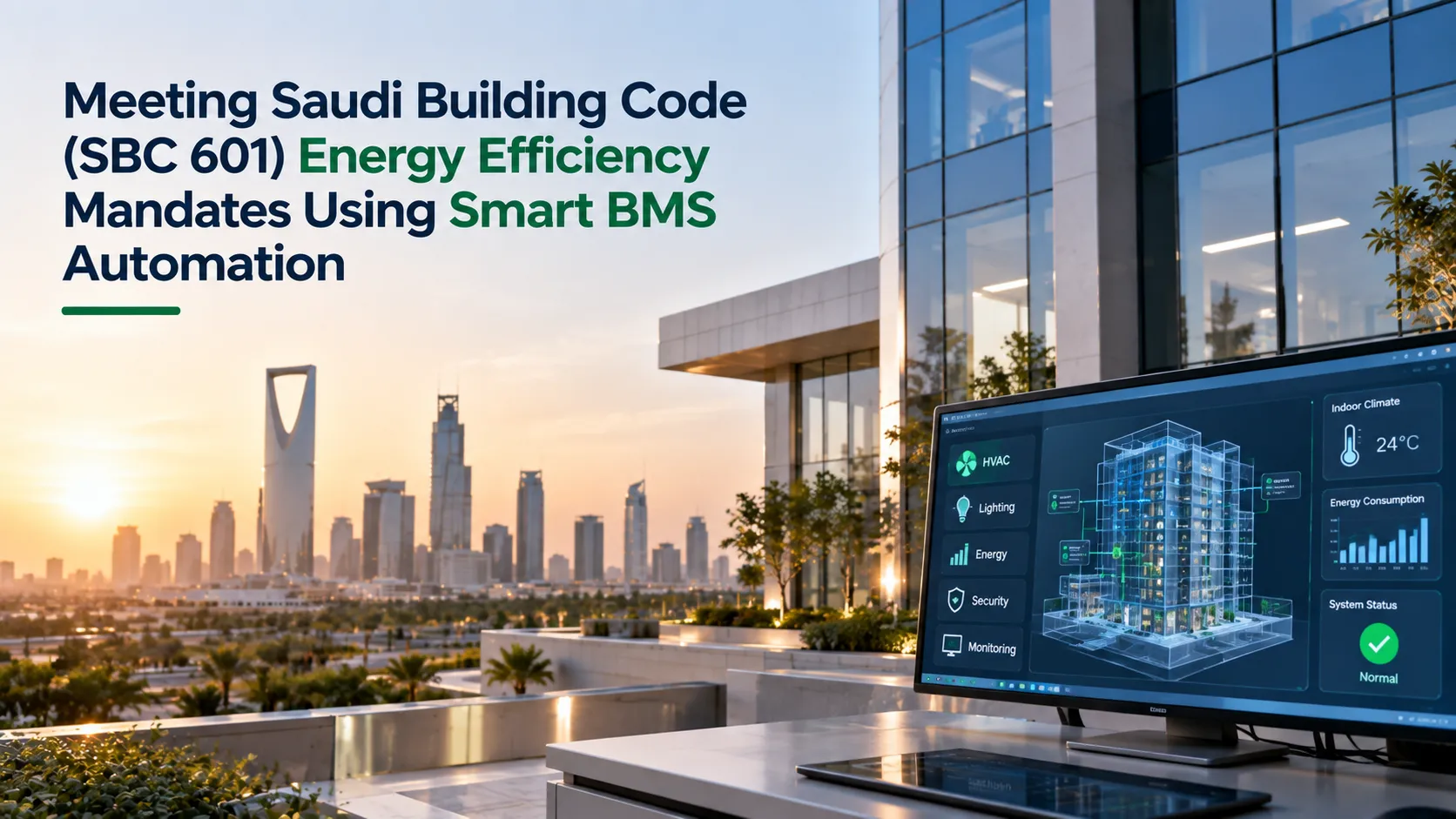
A Building Management System (BMS) ensures SBC 601 compliance in Saudi Arabia by centralizing the real-time monitoring and closed-loop control of mechanical, electrical, and plumbing equipment. By automating HVAC chillers, variable air volume (VAV) terminals, and lighting schedules through native BACnet or Modbus protocols, an engineered BMS reduces total building cooling and electrical loads to satisfy Saudi Building Code energy conservation thresholds.
Why SBC 601 Compliance Drives Facility Engineering in Saudi Arabia
The Saudi Building Code 601 (SBC 601) sets mandatory minimum energy efficiency requirements for commercial, institutional, and high-density residential facilities across the Kingdom. Rapid urbanization across Riyadh, Jeddah, and the Eastern Province has placed massive stress on regional electrical infrastructure. Peak summer ambient conditions routinely surpass 50°C with high relative humidity in coastal areas like Al Khobar and Jubail. These severe environments mean cooling plant infrastructure accounts for 65% to 75% of a commercial facility’s total utility load.
Historically, facilities relied on standalone electro-mechanical thermostats and isolated motor starters. This fragmented control method creates simultaneous heating and cooling, excessive distribution pump pressure, uncontrolled outdoor air infiltration, and continuous unmonitored equipment runtime. SBC 601 eliminates these inefficiencies by mandating strict thermal envelopes, automated lighting shutoff, variable-speed mechanical controls, and sub-metering infrastructure.
Achieving code compliance requires facility managers, MEP consultants, and technical procurement directors to partner with a qualified BMS company Saudi Arabia. Retrofitting or designing a building automation platform from the ground up changes operational expenses from uncontrolled consumption into verifiable, code-compliant utility savings.
Technical Architecture of an SBC 601 Compliant BMS Network
A robust building management architecture relies on a three-tier topology: field instrumentation, digital direct control (DDC) hardware, and supervisory workstation software.
Level 1: Field Instrumentation and Actuation Layer
The field layer contains the sensing hardware and final control elements. Precision measurement dictates control stability. Field deployments use high-accuracy NTC thermistors or PT100/PT1000 RTDs for temperature sensing, capacitive thin-film transmitters for humidity, differential pressure transmitters across air filters and cooling coils, and nondispersive infrared (NDIR) sensors for indoor carbon dioxide detection. These instruments interface with modulating 24V AC/DC electronic actuators on pressure-independent control valves (PICVs) and air dampers, responding directly to control loops through 0-10V or 4-20mA signals.
Level 2: Direct Digital Controllers (DDCs) and Automation Servers
DDCs execute distributed control logic at the equipment level, remaining fully operational even if connection to the central server fails. Controllers host dedicated input/output modules (Universal Inputs, Binary Inputs, Analog Outputs, Binary Outputs) and run deterministic Proportional-Integral-Derivative (PID) routines. Critical plant areas, such as central chiller rooms, utilize redundant DDCs connected via high-speed ring topologies to ensure continuous operation.
Level 3: Supervisory Workstation and Energy Management Software
The supervisory layer consolidates data, hosts historical trending engines, generates automated alarm dispatches, and delivers graphical interfaces to facility engineers. In multi-site enterprises, this tier aggregates performance analytics across distributed real estate portfolios, enabling benchmarking against national SBC energy indices.
Key Automation Strategies for HVAC and Electrical Optimization
Demand-Controlled Ventilation (DCV)
SBC 601 requires strict modulation of outdoor air intake based on space occupancy. Constant-volume ventilation forces cooling equipment to treat unconditioned, humid outdoor air even when spaces are unoccupied. Integrating indoor carbon dioxide sensors with DDC reset schedules allows ventilation dampers to modulate proportionally. Outdoor air intake remains at minimum baseline levels during low occupancy and ramps up smoothly when CO2 levels exceed 800 ppm, preventing thermal over-cooling and reducing latent load.
Chilled Water Plant Optimization
Central chiller plants consume the majority of electrical power in large Gulf facilities. Modern BMS engineering executes automated chilled water reset schedules based on real-time ambient wet-bulb temperatures and internal cooling demands:
- Variable Primary/Secondary Flow Modulation: Modulating variable frequency drives (VFDs) on secondary chilled water pumps according to the most remote hydronic loop’s differential pressure setpoint prevents unnecessary pumping energy.
- Chilled Water Supply Temperature Reset: Raising chilled water temperature by 1°C to 2°C during partial-load conditions increases chiller compressor efficiency by approximately 2% to 4% without compromising indoor occupant comfort.
- Automated Cooling Tower Staging: Staging cooling tower fans using VFD controls to maintain the optimal condenser water temperature entering the chiller prevents high-head-pressure trip states during intense summer peaks.
Automated Lighting Control and Sub-Metering
Under SBC 601 Section 505, interior and exterior lighting systems require automatic shutoff controls, daylight-responsive dimming, and occupancy-based isolation. The BMS integrates seamlessly with DALI-2 (Digital Addressable Lighting Interface) gateways to map light fixtures to occupancy schedules.
Simultaneously, the automation backbone interfaces with energy monitoring devices over Modbus to track branch-circuit power, power factors, and peak kilovolt-ampere (kVA) demand, passing high-frequency telemetry back to supervisory dashboards.
Field Bus Protocol Comparison for Building Automation
Selecting the appropriate field communication protocol is essential to maintain low packet latency, avoid vendor lock-in, and support long-term maintainability.
| Parameter / Feature | BACnet/IP | BACnet MS/TP | Modbus RTU | LonWorks (FT-10) |
| Physical Media | Cat6 / Fiber Optic | RS-485 Shielded Twisted Pair | RS-485 Twisted Pair | Free Topology Twisted Pair |
| Maximum Data Rate | 100 Mbps to 1 Gbps | 9.6 kbps to 115.2 kbps | Up to 115.2 kbps | 78 kbps |
| Maximum Network Nodes | Practically unlimited (switch-based) | Up to 127 per segment (with repeaters) | 31 per segment (up to 247 with repeaters) | Up to 64 per segment |
| Primary Industry Role | Plant controllers, BMS servers, large AHUs | VAV boxes, terminal units, FCUs | Energy meters, VFDs, generator interfaces | Legacy terminal HVAC controls |
| Data Interoperability | Native Object / Property representation | Native Object / Property representation | Register mapping (manual configuration) | Standard Network Variable Types (SNVTs) |
| Fault Isolation | High (isolated switch ports) | Moderate (bus break impacts downstream nodes) | Moderate (line breaks break segment) | High (free topology tolerates splits) |
Integrating BMS Infrastructure with Industrial Power Systems
In industrial facilities across Jubail, Dammam, and Yanbu, building automation systems must exchange data directly with electrical distribution assemblies. High-efficiency HVAC chillers and large air handling units draw heavy power loads directly from primary motor control centers.
Executing comprehensive industrial automation projects requires seamless coordination between mechanical DDC networks and industrial PLCs controlling plant processes. This unified integration guarantees that non-critical HVAC units shed load automatically whenever main electrical switchgear detects high peak demand limits, preventing expensive peak-tariff penalties from the utility provider.
Similarly, reliable field execution depends on certified LV panel manufacturing that complies strictly with IEC 61439-1/2 standards. Control panels housing BMS controllers, relays, 24V power supplies, and network switches must be engineered to withstand high ambient temperatures, electromagnetic noise from nearby VFDs, and conductive dust infiltration common throughout Eastern Province operations.
End-to-End BMS Engineering Lifecycle: From Design to Handover
- Concept and Control Narrative Development: Reviewing MEP design schematics, sequences of operation, equipment schedules, and SBC 601 energy targets. Producing control valve sizing calculations, sensor selection tables, and detailed network topology drawings.
- Shop Drawings and Panel Assembly: Engineering hardware I/O wiring diagrams, control panel layouts, bills of materials, and terminal block schedules. Fabricating IP54/IP65 control enclosures with clean separation between high-voltage power lines and sensitive low-voltage sensor cables.
- Software Programming and System Graphics: Developing deterministic DDC algorithms, safety interlocks (freeze protection, fire smoke purge, smoke detector trips), dynamic web graphics, and system alarm logs.
- Factory Acceptance Testing (FAT): Powering up control panels in a controlled shop environment, injecting simulated 4-20mA and 0-10V signals, running point-to-point software loop tests, and verifying controller communication health before site delivery.
- Site Installation and Cabling: Pulling shielded communication cables away from high-voltage conduit runs, installing field devices, and terminating connections at field terminal boxes.
- Site Acceptance Testing (SAT) and Commissioning: Calibrating all field temperature, pressure, and air quality transmitters. Validating failsafe positions for fire dampers and water control valves. Performing air and hydronic balancing integration, documenting sequence verification, and training client engineering personnel.
Saudi Regulatory Standards and Compliance Frameworks
Designing and installing building automation within the Kingdom requires strict alignment with overlapping national and international engineering standards:
- Saudi Building Code (SBC 601): Mandates specific thermal envelope performance, maximum lighting power densities (LPD), automated HVAC staging controls, continuous economizer requirements, and granular power sub-metering.
- SASO (Saudi Standards, Metrology and Quality Organization): Enforces minimum energy performance standards (MEPS) on variable speed drives, packaged air-conditioning units, and electrical equipment brought into the country.
- Aramco & SEC Engineering Standards: Industrial and utility-scale projects must satisfy internal technical standards (such as SAES and SEC transmission criteria), requiring robust cybersecurity controls, redundant power architectures, and extreme environmental ratings.
- IEC 61439-1/2: Dictates mechanical, electrical, and thermal boundary testing for low-voltage control assemblies and switchboards to guarantee operator safety and equipment longevity under harsh industrial duty.
Frequently Asked Questions
What is the primary role of a BMS in achieving SBC 601 compliance?
A BMS provides automated, real-time control over a building’s most energy-intensive mechanical and electrical assets. By executing occupancy schedules, demand-controlled ventilation, and chilled-water optimization, the BMS prevents energy waste and guarantees the facility operates within SBC 601 consumption parameters.
Which communication protocol is best for commercial BMS in Saudi Arabia?
BACnet/IP is preferred for high-speed supervisory backbones and central plant controllers due to its high bandwidth and vendor-neutral profile. BACnet MS/TP is ideal for terminal equipment like VAVs and fan coil units, while Modbus RTU remains standard for smart power meters and variable frequency drives.
How does demand-controlled ventilation reduce energy use in hot climates?
Demand-controlled ventilation utilizes real-time indoor CO2 readings to adjust outdoor air damper positions. Instead of continuously cooling and dehumidifying large volumes of hot outdoor air, the system introduces only the precise volume of outdoor air needed for current occupancy levels.
Can an existing building be retrofitted with an SBC 601 compliant BMS?
Yes. Retrofitting legacy facilities involves replacing obsolete pneumatic or analog controls with modern DDCs, adding variable frequency drives to existing fan and pump motors, and installing network-connected digital sub-meters to track, measure, and optimize thermal performance.
How does ambient Gulf heat affect BMS sensor and panel specifications?
High ambient temperatures require exterior field sensors to feature UV-resistant housing and robust temperature compensation. Control enclosures require careful thermal management calculations, dedicated ventilation or panel cooling units, and high IP ratings (IP54 to IP65) to prevent dust and humidity ingress.
Engineer Your Facility for Long-Term Energy Performance
Optimizing commercial and industrial facilities to satisfy strict regional energy codes demands rigorous automation engineering. SAS Technology provides end-to-end design, custom control panel assembly, instrumentation supply, and turnkey commissioning across the Kingdom.
Contact our automation and MEP engineering specialists to discuss your upcoming project or code compliance upgrade:
- Headquarters: Dana Towers, Al Khobar, Saudi Arabia
- Phone: +96 6506051781
- Email: sales@saselectrotech.com / info@saselectrotech.com
- Inquiries: SAS Technology Engineering Support