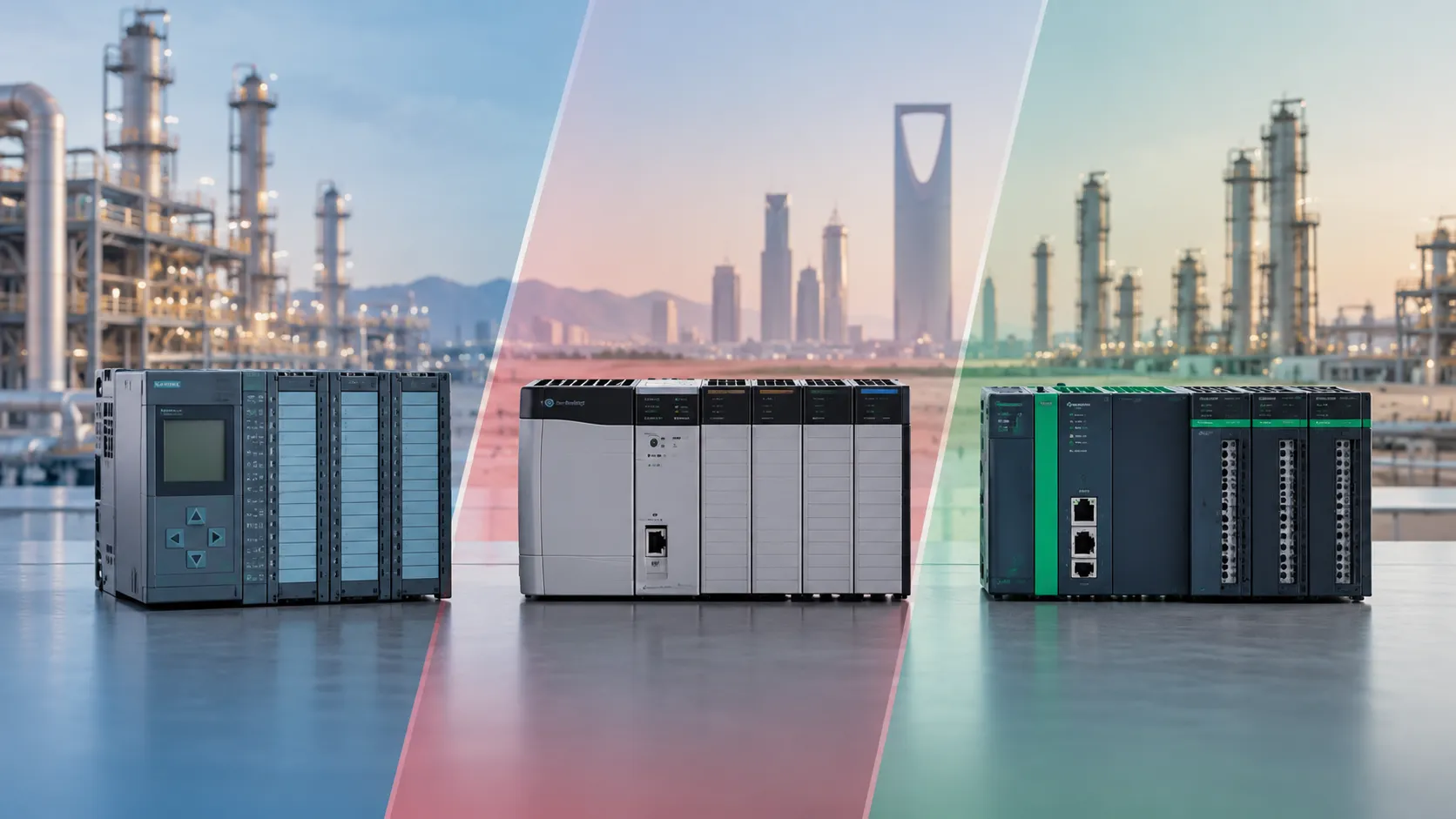
To select the right industrial controller for facilities in Saudi Arabia, automation engineers evaluate process cycle times, communication topologies, lifecycle licensing, and field-device compatibility. Siemens SIMATIC S7-1500 excels in complex discrete and integrated motion control via PROFINET; Allen-Bradley ControlLogix dominates heavy process and oil and gas operations via native EtherNet/IP; Schneider Electric Modicon M580 delivers robust DCS hybrid capabilities with native Ethernet backplanes. Selecting the right platform requires balancing plant standardization against regional vendor availability, environmental operating constraints, and engineering lifecycle costs.
Industrial Automation in Saudi Arabia: The Harsh Operational Reality
Selecting an automation platform across the Kingdom demands more than comparing data sheets. Whether you operate petrochemical processing units in Jubail, manufacturing lines in the Riyadh Industrial Cities (MODON), or water distribution networks across the Eastern Province, your control hardware faces environmental and operational strains unique to this geography.
Ambient summer temperatures routinely exceed 50°C. In high-density control panels, internal enclosure temperatures easily climb past 65°C without properly engineered thermal mitigation. Airborne dust, abrasive silica particulates, and sulfurous corrosive gases in petrochemical corridors corrode standard printed circuit boards. Systems installed without conformal coating (conforming to ISA 71.04 Class G3 or GX harsh environment ratings) develop micro-fissuring and signal cross-talk within 24 months of deployment.
Procurement mandates under Saudi Vision 2030 require strict compliance with Saudi Standards, Metrology and Quality Organization (SASO) rules, Saudi Aramco Engineering Standards (SAES), and National Guard/Royal Commission project guidelines. When executing projects in the Kingdom, plant engineering teams cannot afford controllers that demand hard-to-source proprietary replacement spares, brittle proprietary protocol translation layers, or third-party engineering contractors who lack local field presence. Choosing the wrong controller architecture locks a plant into decades of high total cost of ownership, recurring licensing friction, and unplanned shutdowns during high-ambient-load seasons.
Architectural Breakdown: Siemens SIMATIC S7-1500 & TIA Portal
Siemens remains a dominant automation platform across Europe and Middle Eastern downstream manufacturing, packaging, water treatment, and infrastructure utilities. Centered around the S7-1500 controller family and the Totally Integrated Automation (TIA) Portal engineering suite, Siemens provides deterministic control alongside deep diagnostics.
Processor Performance and Memory Management
The S7-1500 line uses dedicated backplane communications processors alongside high-performance CPUs (from the compact 1511-1PN up to the redundant 1518R/H). Bit processing performance drops as low as 1 nanosecond per integer instruction on flagship units like the CPU 1518-4 PN/DP. Memory allocation separates work memory into independent code and data areas, backed by non-volatile SIMATIC Memory Cards (up to 32 GB) that retain data blocks permanently without requiring buffer batteries.
This discrete memory separation guarantees that dynamic process recipes and telemetry logs survive prolonged power disruptions. Integrated trace engines log up to 64 signals simultaneously in real time directly on the controller chip, isolating intermittent electrical transients before plant engineers deploy external bus analyzers.
(Bit Time: 1 ns to 10 ns)
Synchronization
Remote Racks (Conformal)
Unified / Zenon
Bus Communication and Fieldbus Interfacing
Siemens relies fundamentally on PROFINET IO (IEC 61158 / IEC 61784). Supporting Isochronous Real-Time (IRT) communication, PROFINET delivers deterministic response intervals below 250 microseconds. This makes Siemens the ideal platform for synchronizing multi-axis servo drives, automated logistics sorters, and high-speed bottling plants across food and beverage clusters in Al Kharj and Jeddah.
Field device integration uses standardized GSDML (General Station Description Markup Language) definitions. The platform natively incorporates OPC Unified Architecture (OPC UA) server and client stacks directly inside the controller operating system firmware. This enables direct, encrypted telemetry handshakes with upper-echelon MES databases and enterprise cloud solutions without deploying intermediate protocol gateway appliances.
Engineering Environment: TIA Portal
The Totally Integrated Automation (TIA) Portal consolidates safety (Safety Integrated up to SIL 3 / PLe), multi-axis motion planning, visualization, and PLC programming into a single database. When modifying tag variables in the PLC tag tables, related WinCC SCADA panels and variable frequency drive parameters update instantly across the project tree without tag export/import cycles.
Standardizing on Siemens platforms works best when engineering teams rely on structured text (SCL) and sequential function charts (GRAPH) alongside traditional ladder diagrams (LAD), taking full advantage of object-oriented programming concepts (IEC 61131-3 Edition 3). Deploying this unified logic structure through our certified industrial automation services ensures that plant operators maintain complete cross-system traceability and minimize maintenance cycle times across high-volume production facilities.
Architectural Breakdown: Rockwell Automation Allen-Bradley ControlLogix
Rockwell Automation’s Allen-Bradley platform (Logix 5000 family, led by ControlLogix 5580 and CompactLogix 5380) serves as the entrenched automation backbone across North American heavy industry, offshore extraction platforms, and Aramco-affiliated petrochemical plants throughout the Kingdom’s Eastern Province.
Processor Performance and Memory Management
The ControlLogix 5580 system is built around a single multi-core control processor platform. One computing core executes strict user application logic, while auxiliary cores handle backplane input/output updates, cyclic system tasks, and network traffic concurrently. This multi-core setup prevents communication requests from degrading deterministic loop execution during high-traffic SCADA polling events.
(100% Deterministic Run)
Network Management
Distributed I/O Modules
FactoryTalk SCADA
Logix systems run on a tag-based operating system rather than fixed memory registers. Memory allocation is completely flexible; every variable exists as an explicit, user-named Controller Tag or Program Tag. You can define extensive User-Defined Data Types (UDTs) and modular Add-On Instructions (AOIs). This layout matches the operational requirements of process plants where engineers need clean, human-readable variable hierarchies instead of register conversion matrices.
Bus Communication and Fieldbus Interfacing
Rockwell structures its communication fabric on EtherNet/IP running the Common Industrial Protocol (CIP). By using standard IEEE 802.3 Ethernet transport combined with standard TCP/UDP ports, EtherNet/IP coexists on standard physical networking switches without requiring specialized, vendor-proprietary communication chips.
High-availability operations use Device Level Ring (DLR) network topologies. DLR incorporates a fault-tolerant single-ring protocol directly into the I/O communication modules (such as 1756-EN2TR or 5069-AENTR). If a plant fiber optic segment sustains a mechanical cut or port transceiver failure, the network ring heals in under 3 milliseconds, avoiding rack isolation and preventing spurious emergency shutdown trips.
Engineering Environment: Studio 5000 Logix Designer
Studio 5000 provides industry-leading online editing capabilities. Automation engineers can write, verify, test, and assemble rungs of ladder logic simultaneously on live production machines without halting controller execution or cycling power to the rack.
In continuous process facilities (such as crude stabilization facilities, asphalt plants, and bulk chemical distribution hubs), dropping the PLC into a Stop mode to load an amended logic rung costs tens of thousands of dollars per minute in lost output. The stability of Studio 5000’s online editing engine remains a key reason project engineers prefer Allen-Bradley ControlLogix for critical infrastructure sites across Dammam and Jubail.
Architectural Breakdown: Schneider Electric Modicon M580 ePAC
Schneider Electric pioneered programmable logic with the original Modicon 084. Today, Schneider leads hybrid process automation and safety-critical installations with the Modicon M580, marketed as an Electronic Programmable Automation Controller (ePAC).
Processor Performance and Memory Management
The Modicon M580 family (ranging from BMEP581020 up to the redundant dual-CPU BMEH586040) relies on dual-core ARM processor technology. The M580 is distinguished by its native Ethernet backplane (X-bus plus Ethernet backplane), known commercially as the dual Ethernet backplane.
Logic & Comm Separation
Embedded Security
(Drop-In Hot-Swappable)
System Platform
Standard PLCs run deterministic fieldbus protocols outward from specialized front-facing communication modules. In contrast, the M580 runs 100 Mbps Ethernet communication traces directly across the backplane chassis pins.
Every compatible drop-in module (the Modicon X80 series) talks natively over standard Ethernet. This allows high-resolution diagnostics, power monitoring records, and field device diagnostic arrays to stream continuously across the system without congesting the core program cycle execution time.
Cybersecurity and Native Ethernet Architecture
Cybersecurity vulnerabilities present an ongoing risk to critical utilities across the GCC. The Modicon M580 was the first controller in the world to achieve independent ISA/IEC 62443-4-2 cybersecurity certification, backed by Achilles Level II security verification.
Security features are integrated directly into the processor hardware:
- Firmware code signatures prevent execution of untrusted, manipulated binary files.
- Unused industrial services, communication ports, and diagnostic servers (FTP, HTTP, TFTP) can be hard-locked directly via CPU configuration registers.
- Native encryption locks down memory modifications, securing communications between engineering workstations running EcoStruxure Control Expert and the controller backplane.
- Real-time monitoring flags unauthorized access requests over Modbus TCP or unauthorized connection attempts from untrusted IP ranges.
Engineering Environment: EcoStruxure Control Expert
Programmed using EcoStruxure Control Expert (formerly Unity Pro), the M580 complies fully with all five IEC 61131-3 languages: Ladder Diagram (LD), Function Block Diagram (FBD), Structured Text (ST), Instruction List (IL), and Sequential Function Chart (SFC).
The platform excels in hybrid manufacturing, discrete assembly, water desalination installations, and municipal infrastructure. Its Function Block libraries integrate smoothly with Schneider’s legacy Modicon Premium and Quantum installations. This backward compatibility offers a clean migration path that avoids ripping out existing field wiring harnesses during scheduled turnaround maintenance windows.
Detailed Technical Comparison: Industrial PLC Platforms
The following engineering matrix compares the flagship controller platforms from Siemens, Rockwell Automation, and Schneider Electric across critical operational, hardware, and protocol metrics relevant to plant deployments in the Gulf region:
| Technical Parameter | Siemens SIMATIC S7-1500 (CPU 1518-4 PN/DP) | Rockwell Allen-Bradley ControlLogix 5580 (1756-L85E) | Schneider Electric Modicon M580 (BMEH586040) |
| Core Architecture | Multi-processor discrete execution cores | Dual-core processing (dedicated logic core + comms core) | Dual-core ARM execution processor |
| Bit Execution Speed | 1 ns (Boolean operations) | ~1.4 ns to 3 ns (Instruction dependent) | ~4.7 ns to 9.5 ns (Boolean operations) |
| User Code/Data Memory | Up to 6 MB Code / 60 MB Data (Scalable to 32 GB via SMC) | Up to 40 MB total dynamic tag-based memory | Up to 64 MB program memory (60 MB program + 4 MB data) |
| Native Fieldbus Support | PROFINET IO (RT/IRT), PROFIBUS DP (via CP), OPC UA | EtherNet/IP (CIP), ControlNet, DeviceNet (via bridge) | Ethernet/IP, Modbus TCP (Native across backplane chassis) |
| Backplane Bandwidth | Up to 100 Mbps to 1 Gbps integrated serial backplane | High-speed 1756 chassis backplane bus | Dual Backplane: Legacy X-Bus + 100 Mbps Native Ethernet |
| Hot Swapping (RIUP) | Yes (ET 200SP / ET 200MP distributed stations) | Yes (Removal and Insertion Under Power for all 1756 cards) | Yes (Hot-swappable X80 series modules across live chassis) |
| Maximum Local / Remote I/O | Up to 64,000 digital / 4,000 analog I/O points | Up to 128,000 digital / 4,000 analog I/O points | Up to 61,440 digital / 15,360 analog I/O points |
| Network Redundancy | MRP (Media Redundancy Protocol), redundant CPU sync | DLR (Device Level Ring), Redundancy Modules (1756-RM2) | Dual CPU hot-standby, native RSTP (Rapid Spanning Tree) |
| Embedded Cybersecurity | Secure boot, signed firmware, TLS/PG communication | CIP Security, digitally signed firmware, FactoryTalk Security | ISA/IEC 62443 certified, Achilles Level II, IP/Port lockdown |
| Operating Temperature | -30°C to +60°C (Standard) / -40°C to +70°C (SIPLUS) | 0°C to +60°C (Standard) / -25°C to +70°C (XT Series) | 0°C to +60°C (Standard) / -25°C to +70°C (Harsh ‘C’ Series) |
| Conformal Coating Standard | Standard: Class 3C2; SIPLUS: Class 3C4 & ISA 71.04 G3/GX | Standard: None; Conformal ‘K’ models: ISA 71.04 G3 | Standard: Class 3C2; Harsh: Class 3C3 & ISA 71.04 G3 |
| Online Logic Modifications | Limited changes supported without CPU restart | Full, unrestricted runtime online ladder logic editing | Partial online dynamic configuration changes supported |
| Engineering Software | TIA Portal (Step 7 Professional V18 / V19) | Studio 5000 Logix Designer (V34 / V35 / V36) | EcoStruxure Control Expert V15+ (formerly Unity Pro) |
| Primary Regional Market Fit | Machine automation, discrete lines, utilities, metals | Oil & gas upstream/downstream, petrochemicals, mining | Water treatment, desalination, HVAC networks, smart cities |
SCADA and Plant-Floor Integration Topologies
A programmable controller does not function in isolation. The value of your automation platform depends heavily on its ability to integrate with supervisory control, remote telemetry, and industrial communication backbones across your facilities.
SCADA Automation
Networking Switches
Motor Control Centers
(HART / Foundation)
High-Speed SCADA Client Integration
Integrating a multi-vendor plant floor with supervisory visualization suites requires high-bandwidth, stable communication drivers. Siemens connects natively to WinCC Unified through internal S7 communication profiles, and also communicates smoothly with cross-platform engines like Copa-Data Zenon over industrial Ethernet.
Rockwell systems pair directly with FactoryTalk View Site Edition (SE) via native FactoryTalk Live Data services. This architecture auto-discovers tag definitions, alarm levels, and engineering units configured in Logix 5000, eliminating duplicate variable mapping.
Schneider Modicon relies on Open Field Device Architecture (OFDA) and native Modbus TCP/EtherNet/IP bridges, linking into AVEVA System Platform (formerly Wonderware) and EcoStruxure Plant SCADA (formerly Citect).
Factory Electrical Substation Automation Integration
Large industrial facilities in Saudi Arabia generate and distribute their own medium-voltage and low-voltage power. Coordinating plant automation with incoming electrical switchgear requires linking standard PLCs with intelligent electronic devices (IEDs) monitoring circuit breakers and feeder lines. When designing unified electrical topologies, plant managers link industrial logic engines with dedicated substation SCADA automation running IEC 61850 protocols.
Standard controllers handle standard process loops, while IEC 61850 MMS and GOOSE (Generic Object Oriented Substation Events) messaging route directly into high-speed automation controllers. This design orchestrates millisecond-accurate load shedding, power transfers, and harmonic tracking across the electrical balance of plant.
Motor Control Center Integration
Modern automation systems connect down into motor management networks. Instead of hardwiring every start/stop push button and auxiliary contact back to raw digital I/O channels, modern facilities link controllers to smart motor managers (such as Siemens SIMOCODE, Allen-Bradley E300, or Schneider TeSys T). These motor managers mount directly inside fully compliant LV panel manufacturing enclosures built to IEC 61439 Form 4b standards.
Running continuous digital diagnostics over a single redundant fieldbus cable saves thousands of meters of field wiring. It also gives maintenance teams real-time data on motor operating current, thermal capacity utilization, insulation resistance, ground fault leakage, and phase imbalances.
Environmental Engineering: Surviving Gulf Industrial Climates
Controllers deployed throughout Saudi Arabia face harsh operating environments. High summer temperatures degrade solid-state silicon, dry out electrolytic capacitors, and cause power supply failures if control panels are poorly designed. When specifying automation hardware for regional plants, our engineering teams focus on three key environmental safeguards:
(Eliminates H2S / Cl2 Corrosion)
(Closed-Loop Air Cond. > 45°C Ambient)
(Isolates Heavy Inductive Load Spikes)
Conformal Coating Requirements
In environments containing airborne hydrogen sulfide ($H_2S$), sulfur dioxide ($SO_2$), chlorine gas ($Cl_2$), or marine coastal salt spray (typical around Jubail, Yanbu, Dammam, and Rabigh), standard commercial copper circuit traces oxidize rapidly. This chemical breakdown leads to dendritic silver creeping and short-circuit faults across fine-pitch processor pins.
Engineers must specify conformally coated product variants:
- Siemens: Select the SIPLUS extreme line. SIPLUS modules match standard S7-1500 or ET 200SP pin-outs while adding polymeric protective coatings compliant with EN 60721-3-3 Class 3C4 and ISA 71.04 Class GX environments. They also expand operating limits to 100% relative condensing humidity and extreme temperature ranges up to 70°C.
- Rockwell Automation: Choose the Extreme Temperature (‘XT’) ControlLogix variants, along with modules ending with the ‘K’ catalog suffix. These modules include conformal coatings tested to survive 200 hours of aggressive salt fog exposure under ASTM B117 standards.
- Schneider Electric: Specify the Modicon Harsh (‘C’) series. These units feature conformal coatings applied over all internal boards, rated for IEC 60068-2-60 mixed gas tests and operating temperatures from -25°C to +70°C.
Control Panel Climate Control Design
No PLC will last if the internal enclosure temperature exceeds its maximum rated threshold. Standard control enclosures cannot rely on simple ambient vent fans when external temperatures hit 50°C. Blowing hot, dusty ambient air through filter mats into an electrical panel accelerates thermal throttling and invites particulate contamination.
Industrial control panels installed in the Kingdom must use sealed closed-loop air conditioning units (minimum IP54/IP65 ratings) featuring treated condenser coils. Sizing calculations must account for the panel’s external surface area, incident solar radiation loads, and total heat generation from internal equipment (including PLC power supplies, auxiliary 24 VDC power supplies, managed network switches, and variable frequency drives).
Step-by-Step Engineering Lifecycle: From Sizing to Site Acceptance Testing (SAT)
Deploying a reliable programmable logic controller requires a structured, multi-phase engineering process. Following this engineering workflow prevents costly logic rewrites, simplifies integration, and ensures complete alignment between plant designs and operational realities:
Analysis
Architecture
FAT Testing
& Handover
Phase 1: Requirements Analysis and System Sizing
- I/O Point Audit: Calculate digital and analog I/O points, categorizing them by signal type (4-20 mA HART, RTD, thermocouple, discrete dry contacts). Add a mandatory 20% installed spare capacity across all chassis slots and terminal blocks.
- Scan Time and Loop Speed Calculations: Calculate the required control execution frequency. High-speed emergency protection and packaging servo axes demand logic cycle times below 10 ms. Standard continuous temperature and pressure loops operate cleanly with 50 ms to 100 ms cycle times.
- Redundancy Evaluation: Decide if your process warrants a single CPU, hot-standby redundant processors (such as Siemens 1515R/H, Rockwell 1756-RM2, or Schneider BMEH58), or a safety-instrumented architecture (SIL 2 / SIL 3).
Phase 2: Control Architecture Design and Fieldbus Layout
- Network Topology Design: Map out your physical Ethernet segments, fiber optic backbones, managed switch placements, and fault-tolerant network topologies (DLR or MRP rings).
- Power Distribution Engineering: Isolate sensitive 24 VDC instrumentation loops from inductive coil loads. Install redundant, diode-decoupled power supplies backed by modular uninterruptible power supply (UPS) units.
- Thermal Management Engineering: Complete thermal dissipation calculations for every enclosure to choose the right panel cooling systems.
Phase 3: Logic Development and Factory Acceptance Testing (FAT)
- Modular Software Engineering: Build the application logic using modular, standardized function blocks (IEC 61131-3). Structure all tags with clear, human-readable naming conventions and configure diagnostic alarm blocks.
- Factory Acceptance Testing (FAT): Test the completed control panels alongside the logic program at the panel manufacturing facility before shipping hardware to the site. Connect the system to hardwired I/O simulation racks, inject open-circuit faults, force abnormal process trips, and confirm fail-safe shutdowns under load.
Phase 4: Site Installation, SAT, and Commissioning
- Cold Loop Checking: Verify physical wire continuity, measure insulation resistance (Megger checks), verify correct loop power polarity, and confirm zero stray AC ground currents across shielding circuits.
- Hot Loop Testing: Inject calibrated current loops (4 mA, 8 mA, 12 mA, 16 mA, 20 mA) to verify analog scaling matches between local transmitters, PLC data registers, and supervisory SCADA graphic displays.
- Site Acceptance Testing (SAT): Execute functional tests in the field alongside plant operating personnel. Tune PID loops under live operating loads, confirm that automatic network failovers work properly, and archive all final program backups.
Regulatory Compliance & Engineering Standards in Saudi Arabia

Industrial plants built in the Kingdom must meet a demanding matrix of national and international engineering standards:
International Electrotechnical Commission (IEC) Standards
- IEC 61131-3: The global standard for programmable logic controllers, defining standard program execution rules and languages: Ladder Diagram (LD), Function Block Diagram (FBD), Structured Text (ST), Instruction List (IL), and Sequential Function Chart (SFC).
- IEC 61439-1/2: Regulates low-voltage switchgear and controlgear assemblies, setting strict rules for internal separation forms (Form 2a up to Form 4b), creepage distances, short-circuit withstand capabilities, and temperature-rise limits.
- IEC 62443: The standard for industrial automation cybersecurity, requiring secure network zone segmentation, robust access controls, encrypted device communication, and strict firmware validation.
Saudi Building Code (SBC) and SASO Standards
- SBC 601 (Energy Conservation): Demands high-efficiency electrical infrastructure and strict control over thermal, mechanical, and motor loads across industrial and commercial facilities.
- SASO Approvals: All automation panels, controllers, power supplies, and terminal equipment must hold valid SASO Certificates of Conformity before clearing Saudi customs ports and being powered up on site.
Industrial Major Standards (Aramco & SEC References)
- SAES-J-601: Specifies technical standards for industrial control systems, covering field cabling topologies, system redundancy options, grounding techniques, and controller fail-safe states.
- SEC Substation Automation Specs: Sets strict communication and testing requirements for integrating substation automation systems with main dispatch centers via IEC 61850.
Frequently Asked Questions
Which PLC platform is most widely used across manufacturing plants in Riyadh?
Siemens and Rockwell Automation hold the largest market share in Riyadh. Siemens is widely used across discrete packaging, food and beverage processing, plastics manufacturing, and automated utilities. Rockwell Automation remains common in plants tied to oil, gas, and heavy manufacturing supply chains.
Can an Allen-Bradley ControlLogix controller talk directly to a Siemens S7-1500 system?
Yes, using an industrial protocol gateway or native Ethernet communications. The most reliable approach uses an Anybus or ProSoft gateway module to translate PROFINET to EtherNet/IP cyclically. Alternatively, both controllers can share data seamlessly by running one as an OPC UA client and the other as an OPC UA server over a shared plant network.
What is the advantage of using a native Ethernet backplane like the Schneider Modicon M580?
The M580 runs 100 Mbps Ethernet communication traces directly across the backplane pins. This allows I/O modules, motor management relays, and field instrumentation to share high-resolution diagnostic data at full network speeds, without consuming the main CPU program execution cycle.
When should our plant select conformally coated PLC hardware?
You should specify conformally coated modules (such as Siemens SIPLUS, Allen-Bradley XT, or Schneider Harsh) whenever equipment operates in coastal, humid, or chemically corrosive environments like Jubail or Dammam. Conformal coatings protect circuits against sulfurous gases, airborne dust, and high humidity, preventing premature hardware failure.
What is the practical difference between TIA Portal and Studio 5000 for day-to-day operations?
TIA Portal combines PLC programming, HMI screen development, motion control, and safety configurations into a single, unified database. Studio 5000 excels in tag-based, human-readable structuring and features powerful online logic editing capabilities, allowing engineers to modify rungs live without stopping production.
Engineering Support and Integration Services
Selecting the right automation platform determines your plant’s operational stability, maintenance costs, and productivity for the next two decades. Whether you are standardizing a plant-wide architecture in Jubail, expanding packaging lines in Riyadh, or modernizing control systems across Dammam, SAS Technology provides the local engineering expertise to deliver robust, compliant automation projects.
Our team designs, programs, builds, and commissions turnkey industrial control systems tailored to your operating requirements:
- Custom Software Engineering: Expert programming for Siemens TIA Portal, Rockwell Studio 5000, and Schneider EcoStruxure platforms.
- Control Panel Manufacturing: Custom-built LV and MCC panels built to IEC 61439 Form 4b standards, fully compliant with SASO regulations.
- On-Site Commissioning & Testing: Comprehensive Loop Checking, Factory Acceptance Testing (FAT), and Site Acceptance Testing (SAT) performed by experienced, Kingdom-based field engineers.
Discuss your upcoming automation, SCADA, or control system project with our engineering team:
- Headquarters: Dana Towers, Al Khobar, Kingdom of Saudi Arabia
- Direct Engineering Line: +96 6506051781
- Technical Inquiries: info@saselectrotech.com / sales@saselectrotech.com
- Project Consultation Form: https://saselectrotech.com/contact-us/