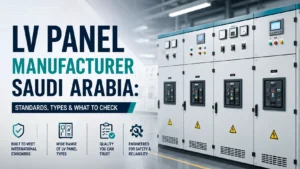
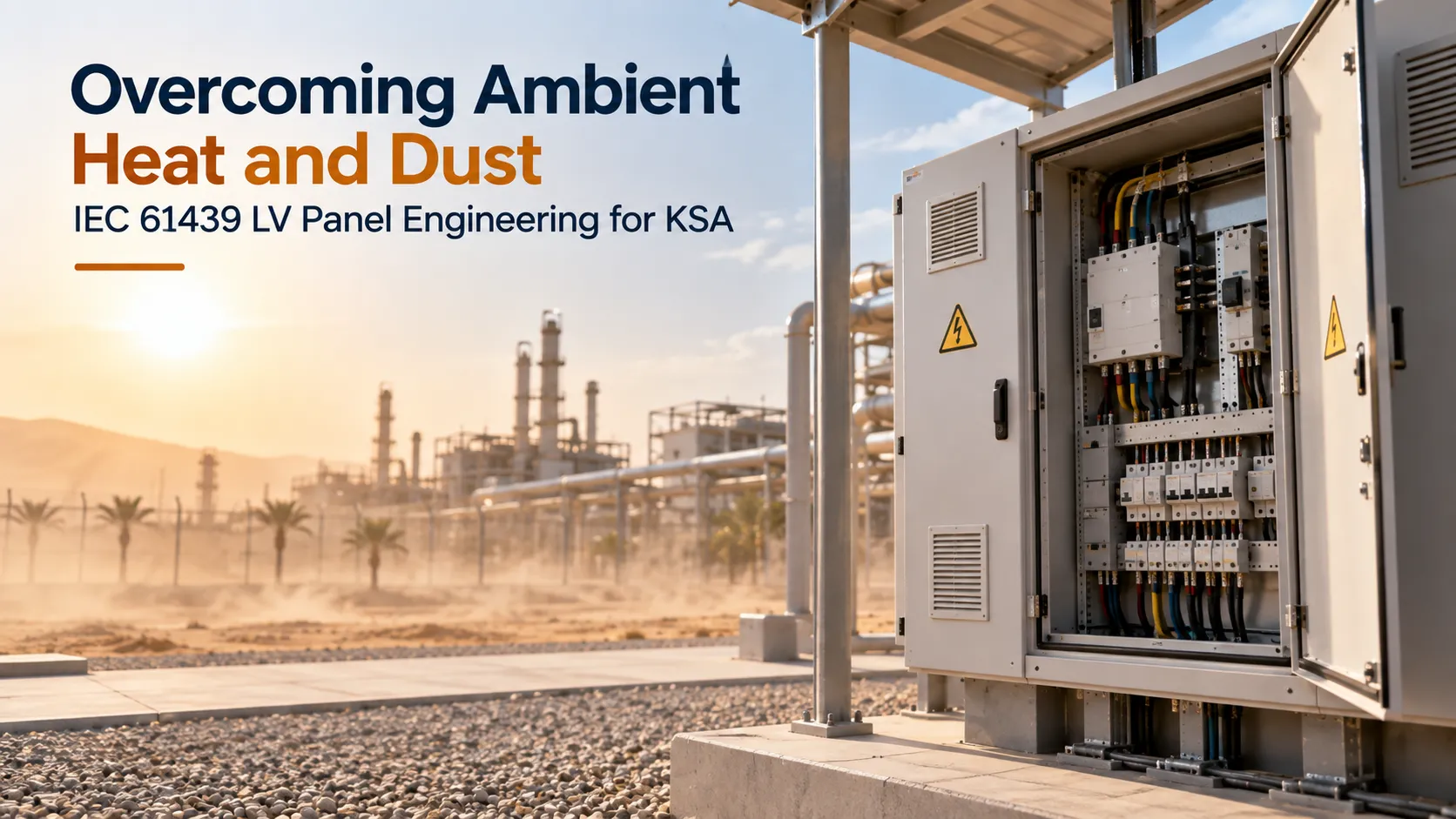
Low-voltage switchgear and Motor Control Centers (MCCs) operating in Saudi Arabia require specialized thermal de-rating, strict Form 4 internal separation, and sealed ingress protection (IP54 to IP65) to survive ambient temperatures exceeding 50°C and airborne particulate loading. As a certified LV panel manufacturer Saudi Arabia trusts, SAS Technology designs, builds, and tests IEC 61439-1/2 compliant low-voltage assemblies that prevent nuisance thermal tripping, manage busbar heat dissipation, and eliminate abrasive sand ingress across harsh industrial environments.
The Engineering Challenge: Low-Voltage Assemblies in Extreme GCC Climates
Operating low-voltage distribution assemblies in the Gulf Cooperation Council (GCC) region presents environmental stressors that standard catalog switchboards cannot handle. In Jubail, Yanbu, Dammam, and interior desert sites, industrial facilities routinely face ambient air temperatures reaching 50°C to 55°C during summer months. Direct solar radiation on exterior switchgear enclosures can push surface skin temperatures above 70°C.
Standard catalog assemblies rated under baseline IEC standards assume a daily average ambient temperature of 35°C and an instantaneous peak of 40°C. Placing an unadjusted, off-the-shelf panel into a Saudi Arabian petrochemical plant, quarry, or water treatment station leads directly to catastrophic thermal breakdown. When internal enclosure temperatures breach component limits, electronic trip units on air circuit breakers (ACBs) and molded case circuit breakers (MCCBs) drift out of calibration, causing nuisance tripping or failing to clear true short-circuit events.
Atmospheric particulate loading compounds the extreme heat. The Arabian Peninsula features fine, silica-heavy sand and airborne dust with grain sizes dropping below 50 microns. In coastal industrial hubs like Jubail and Al Khobar, this dust mixes with ambient relative humidity exceeding 90% and airborne chlorides. The resulting conductive, corrosive slurry deposits onto copper busbars, ventilation louvers, and secondary disconnect contacts, accelerating tracking breakdowns and phase-to-phase arc faults.
Mitigating these destructive forces requires moving beyond generic enclosure assembly. Switchgear design engineers must implement rigorous mathematical thermal de-rating, advanced ventilation modeling, robust Form 4 compartmentalization, and automated motor controls that link seamlessly with plant-wide industrial automation architectures.
Thermal De-Rating Dynamics: Calculating True Ampacity at 50°C+ Ambient
Temperature rise inside an LV panel is governed by the $I^2R$ power losses generated by current flowing through busbars, breakers, and internal conductors, combined with heat radiated from coils, drives, and auxiliary transformers. Under IEC 61439-1, the permissible temperature rise limits for internal parts are strictly defined relative to an ambient baseline.
When the reference ambient temperature increases from 35°C to 50°C or 55°C, the allowable temperature rise buffer ($\Delta T$) shrinks significantly. If a terminal block has a maximum absolute thermal threshold of 105°C, an ambient design base of 35°C allows a 70 K rise. At a 55°C ambient base, that allowable rise drops to 50 K. Failure to compensate forces components past their molecular insulation limits, initiating rapid dielectric degradation.
Circuit breakers experience both mechanical and electronic de-rating under these conditions:
- Thermal-Magnetic Breakers: High ambient temperatures pre-heat the internal bi-metallic strip. The trip unit perceives this ambient heat as overload current, causing the breaker to trip well below its nominal operating ampacity.
- Electronic Trip Units (ETUs): While microprocessors sample current digitally via Rogowski coils or current transformers (CTs), the power electronics and rating plugs still suffer accelerated aging and thermal saturation if internal panel temperatures exceed 70°C.
- Busbar Sizing Adjustments: Standard design rules allowing current densities of 1.6 A/mm² to 2.0 A/mm² for copper must be discarded. For high-ambient Gulf installations, busbar cross-sectional areas must be enlarged to target conservative current densities between 1.2 A/mm² and 1.4 A/mm², often requiring parallel bar configurations with dedicated convection gaps.
To ensure long-term stability, breaker frame sizes must be upgraded. A 1600 A incoming load in a 50°C ambient environment cannot be served by a 1600 A frame breaker operating at full capacity. Applying an ambient correction de-rating factor ($k_t$) of 0.82 requires upsizing the switchgear to a 2000 A frame to sustain continuous operation without thermal tripping.
Form Separation Architectures: Why Form 4b is Mandatory for Heavy Industry
The IEC 61439-2 standard defines internal separation forms to protect operators against accidental contact with live parts and to contain internal arc faults or contamination within localized zones. In critical infrastructure across Saudi Arabia, including utility substations, refineries, and continuous-process manufacturing lines, Form 4 separation is the standard specification.
Form separation divides low-voltage switchboards into three distinct functional entities:
- Busbars: Main horizontal and vertical distribution bars.
- Functional Units: Circuit breakers, motor starters, variable frequency drives, and switch-disconnector units.
- Terminations: Cable connection points for incoming and outgoing field power cables.
The differences between Form 3 and Form 4, as well as the sub-variants 4a and 4b, dictate facility safety and maintenance downtime:
- Form 3b: Separates the busbars from functional units, and separates functional units from one another. However, outgoing cable terminations are housed in a shared, common termination chamber. If a technician terminates a new cable for an added motor starter, an accidental slip of a wrench can drop conductive debris across neighboring, energized load terminations.
- Form 4a: Isolates terminations from the main busbars, but groups the outgoing cable terminations in the same compartment as the functional unit itself.
- Form 4b: Provides the highest practical level of mechanical protection. Busbars are fully isolated from functional units, functional units are isolated from each other, and the outgoing cable terminations for each functional unit are housed within their own dedicated, segregated compartment.
Form 4b construction ensures that a short circuit, insulation burn-out, or cable termination failure inside one motor starter bucket remains completely contained within that cell. Toxic ionization gases and copper plasma are vented out through engineered pressure-relief flaps rather than propagating down the panel lineup. Furthermore, maintenance crews can pull and land field cables in a dedicated termination cell while adjacent circuits remain energized, minimizing costly plant shutdowns.
Ingress Protection vs. Heat Dissipation: Resolving the IP54 vs. IP65 Conflict
Specifying ingress protection for desert environments presents an engineering paradox: higher IP ratings block particulate ingress, but simultaneously trap internal heat.
Enclosures rated at IP65 provide complete protection against dust deposits (dust-tight) and protect against multi-directional water jets. However, an IP65 rating requires completely sealed gasketing without unassisted open air louvers. Achieving this seal eliminates natural convective airflow, turning the low-voltage enclosure into a sealed thermal insulator. If the switchgear houses heat-generating assets such as soft starters, VFDs, or harmonic filters, an unventilated IP65 enclosure will rapidly heat up internally, exceeding safe thermal limits within minutes of full-load operation.
To resolve this issue, engineers deploy two specialized design methodologies:
Forced Convective Ventilation with Positive Pressure (IP54)
For panels located in standard plant switchgear rooms or sheltered electrical houses (E-Houses), IP54 is typically preferred. The system uses high-throughput push-pull fan systems equipped with washable, dense micro-fiber filter mats. The mechanical layout maintains a positive internal pressure relative to the outside room. Even if door gaskets wear over time or cable gland plates have minor imperfections, air pushes outward, preventing sub-micron dust from entering.
Closed-Loop Heat Exchangers and Panel Air Conditioners (IP55 to IP65)
For extreme environments, such as outdoor installations or unconditioned industrial sheds near processing equipment, closed-loop cooling is mandatory. The internal air volume of the switchgear is sealed off from the ambient atmosphere using polyurethane or neoprene robotic foamed gaskets. Heat is rejected through external cooling systems:
- Closed-Loop Air Conditioners: Heavy-duty, industrial-grade cooling units featuring tropicalized compressors, Blygold-coated condensing coils to prevent chloride corrosion, and digital thermostats configured with wide hysteresis loops to eliminate compressor short-cycling.
- Air-to-Air Heat Exchangers: Heat pipe assemblies that transfer internal heat to the exterior environment through aluminum transfer fins without exchanging any internal air with the dusty, humid outdoor air.
Smart Motor Control Center (MCC) Architectures in the KSA Industrial Sector
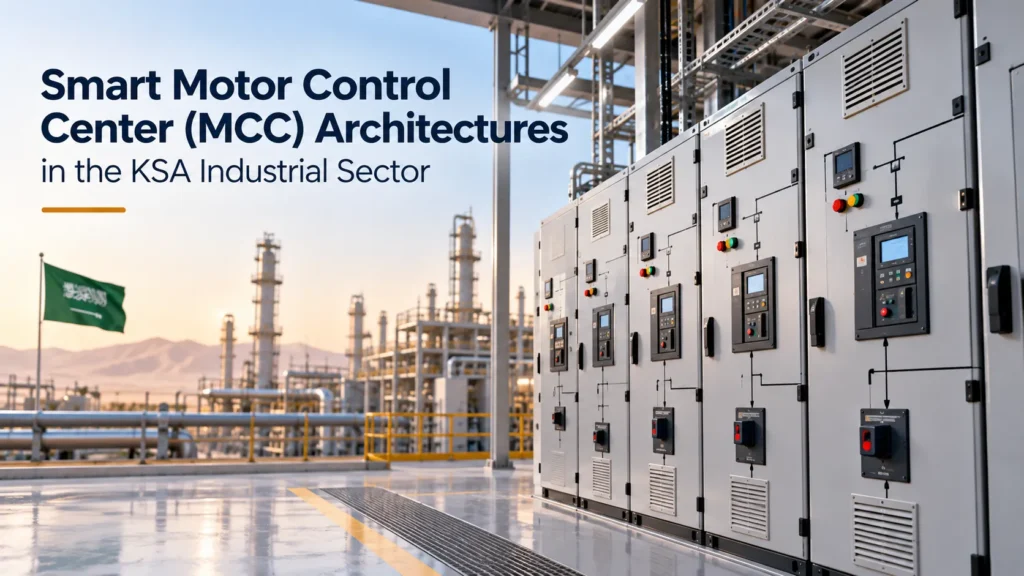
Modern manufacturing and processing plants across Saudi Arabia are replacing traditional hardwired motor control centers with intelligent, networked low-voltage assemblies. A smart MCC replaces massive bundles of discrete 24 VDC or 110 VAC control wiring with deterministic industrial communication networks.
Smart MCCs integrate microprocessor-based motor management relays directly into withdrawable starter buckets. These relays monitor continuous line metrics including phase currents, voltage imbalances, ground-fault leakage, thermal capacity models, power factors, and motor bearing temperatures via RTD inputs.
These intelligent drawers communicate directly with supervisory systems via industrial fieldbus protocols:
- EtherNet/IP and PROFINET: High-speed deterministic protocols delivering sub-millisecond process diagnostics to plant PLCs and distributed control systems (DCS). Network topologies utilize Media Redundancy Protocol (MRP) or Device Level Ring (DLR) architectures, ensuring that a single severed network drop does not drop the communication link to other operational starters.
- Modbus TCP / RTU: Common interface networks for integrating auxiliary balance-of-plant systems, environmental cooling status, and localized energy sub-metering.
Integrating smart MCCs with site-wide supervisory frameworks unlocks predictive maintenance. Operations teams can track contactor contact erosion, monitor total runtime hours, detect elevated motor winding temperatures before insulation breaks down, and capture pre-trip and post-trip wave records. This diagnostic visibility links directly to plant turnkey engineering, supply, and installation execution, ensuring that electrical hardware and supervisory software function as a unified operational asset.
Engineering Comparison: Conventional vs. High-Ambient Desert-Spec LV Switchgear
The following engineering matrix outlines the technical differentiators between standard commercial-grade switchboards and heavy-duty, high-ambient low-voltage switchgear engineered for GCC industrial applications.
| Technical Parameter | Standard Commercial Switchboard (Baseline IEC) | High-Ambient Industrial Switchgear (KSA/GCC Spec) | Engineering Justification for GCC Application |
| Design Ambient Temp ($T_{amb}$) | 35°C average, 40°C peak | 50°C continuous, 55°C peak design | Prevents systematic component overheating and continuous nuisance tripping under summer load profiles. |
| Busbar Current Density | 1.6 to 2.0 A/mm² (Copper) | 1.2 to 1.4 A/mm² (Cu, Tin-Plated) | Reduces $I^2R$ thermal dissipation, maintaining busbar temperatures within IEC 61439 limits at 50°C ambient. |
| Ingress Protection (IP) | IP31 to IP41 (Perforated Sheet) | IP54 (Forced Air) or IP55/65 (Closed-Loop AC) | Prevents micro-fine silica dust, airborne salts, and moisture ingress from causing dielectric breakdown. |
| Internal Separation Form | Form 1 or Form 2b | Form 4b (Metallic Partitions) | Completely isolates busbars, functional units, and individual cable terminations to prevent arc propagation. |
| Enclosure Material & Finish | 1.5mm Cold-Rolled Steel; Powder Coated | 2.0mm to 2.5mm Electro-Galvanized or 316L SS; C5-M Marine Coating | Resists severe atmospheric corrosion driven by high coastal humidity, airborne chlorides, and chemical vapors. |
| Busbar Joint Plating | Bare Copper or Flash Silver | Minimum 10–15 μm Electro-Tin Plating with Torque Indicators | Eliminates galvanic corrosion and prevents joint oxidation, which rapidly increases resistance under thermal cycling. |
| Cooling Methodology | Natural Convection / Unfiltered Fans | Closed-loop Air Conditioning or Positive-Pressure Multi-Stage Filtered Air | Maintains internal electronics below 40°C while preventing dust migration into the enclosure volume. |
| Short-Circuit Withstand ($I_{cw}$) | 36 kA to 50 kA for 1 second | 65 kA to 100 kA for 1 second (Fully Type Tested) | Handles high fault energy levels common in heavy industrial networks, petrochem substations, and large generation plants. |
The Engineering Lifecycle: From Thermal Modeling to Site Acceptance Testing (SAT)
Delivering fully certified, durable low-voltage switchgear requires an end-to-end engineering and quality-assurance process. Cutting corners during design or fabrication inevitably leads to field failures during extreme summer conditions.
- Front-End Engineering Design (FEED) & Heat Rise Calculations: Design validation begins with mathematical modeling rather than manual estimation. Engineers run calculations following IEC 60890 to assess temperature rise across single- and multi-compartment enclosures. The thermal dissipation of every functional device, busbar run, and cable drop is calculated to determine internal operating temperatures under worst-case ambient conditions (55°C outdoor, 40°C switchroom failure scenario).
- Sheet Metal Fabrication and Environmental Coatings: Enclosure structural frames are constructed using CNC-punched, rigid 2.0mm to 2.5mm electro-galvanized sheet steel. For outdoor units installed along coastal areas, grade 316L stainless steel is utilized. Metal panels undergo an eight-stage chemical pre-treatment process followed by electrostatic polyester powder coating to a minimum dry film thickness (DFT) of 80 to 120 microns, satisfying ISO 12944 corrosivity category C4 or C5-M.
- Factory Acceptance Testing (FAT) Protocol: Before leaving the assembly facility, the switchboard undergoes comprehensive quality verification witnessed by client representatives. This includes high-voltage power-frequency dielectric testing (2.5 kV to 3.5 kV for 60 seconds per IEC 61439-1 Clause 10.9), primary current injection to verify protection curves and CT ratios, insulation resistance testing at 1000 VDC (>100 MΩ threshold), and complete functional verification of electrical and mechanical interlocking schemes.
- Site Acceptance Testing (SAT) and Commissioning: Following transport and alignment on site foundation channels, field engineers re-torque all busbar shipping splits to exact Newton-meter specifications using calibrated torque wrenches and apply torque-seal witness marks. After re-checking insulation resistance to ensure no transit damage occurred, assemblies undergo functional loop checks with field sensors, automation controls, and upstream switchgear before final step-loaded energization.
Regulatory Codes and Regional Standards Compliance
Building compliant low-voltage switchgear in Saudi Arabia requires navigating a multi-layered framework of international engineering standards, regional performance codes, and strict utility specifications.
- IEC 61439-1 and IEC 61439-2: The benchmark international standard governing low-voltage switchgear and controlgear assemblies. IEC 61439 eliminated the outdated concepts of “Type-Tested Assemblies” (TTA) and “Partially Type-Tested Assemblies” (PTTA). It mandates that every panel design be validated through thirteen rigorous design verifications, covering temperature rise limits, dielectric properties, short-circuit withstand strength, clearances, and mechanical operation.
- SASO and the Saudi Building Code (SBC): Low-voltage assemblies sold and installed in Saudi Arabia must comply with the Saudi Standards, Metrology and Quality Organization (SASO) requirements and register through the Saber electronic platform. Furthermore, installations must align with SBC 401 (Electrical Installations) and SBC 601 (Energy Conservation Standard). SBC 601 imposes strict efficiency thresholds on sub-metering, requiring integrated smart power quality meters on all major distribution panels to track facility energy consumption.
- IEC TR 61641 (Internal Arc Fault Containment): For facilities prioritizing human safety, such as petrochemical plants and mining substations, compliance with IEC TR 61641 is critical. Panels tested to this standard include arc barriers, heavy-duty door locking mechanisms, insulated busbar systems, and upward-deflecting pressure relief vents that safely direct burning gases upward and away from operating personnel.
- Industrial Utility Standards (Aramco SAMSS and SEC): Projects operating under the jurisdiction of major regional operators must meet strict local corporate engineering requirements. Saudi Aramco Materials System Specifications (SAMSS) such as 16-SAMSS-518 (Low Voltage Switchgear) and 16-SAMSS-503 (Indoor Control Centers) demand verified performance characteristics, including minimum 2.0mm steel sheet thicknesses, mandatory Form 4b internal separation, restricted usage of specific insulation materials, and verified performance under continuous 50°C ambient temperatures.
Frequently Asked Questions
How does high ambient temperature affect the sizing of an LV circuit breaker?
High ambient temperatures pre-heat the thermal elements of circuit breakers and reduce the heat-dissipation efficiency of electronic modules. A breaker rated for 1000 A at an IEC baseline of 40°C may de-rate to roughly 800 A to 850 A in a 50°C to 55°C environment. Engineers must apply manufacturer-certified temperature de-rating correction factors ($k_t$) and select larger breaker frame sizes to prevent false tripping and carry the true full-load continuous current safely.
What is the practical difference between Form 4a and Form 4b internal separation?
In Form 4a assemblies, outgoing cable terminations are housed in the same internal compartment as the functional unit (the circuit breaker or starter). In Form 4b construction, the outgoing cable terminations are separated into their own dedicated, segregated compartment away from the functional unit. Form 4b allows personnel to safely land or service field cables in the termination space without being exposed to live components in the functional unit area.
Can an IP65 enclosure be used for high-power Motor Control Centers without active cooling?
No. An IP65 enclosure is sealed against water and dust, which prevents natural convective airflow. High-power Motor Control Centers generate substantial heat through breaker contacts, busbars, and motor starters. Without active closed-loop cooling, such as industrial panel air conditioning units or sealed air-to-air heat exchangers, internal panel temperatures will quickly climb past safe operating thresholds, leading to rapid component damage and fire hazards.
Why is tin-plated copper preferred over bare copper for busbars in Saudi Arabia?
In coastal industrial areas like Jubail, Dammam, and Yanbu, the atmosphere carries high concentrations of airborne moisture, salts, and industrial sulfur compounds. Bare copper oxidizes quickly in these conditions, forming a resistive surface film that drives up joint operating temperatures and accelerates failure. Electro-tin plating provides a protective barrier against corrosion, maintaining low contact resistance across all busbar joints over decades of thermal cycling.
What parameters are required for IEC 61439 temperature rise verification?
IEC 61439 Clause 10.10 requires verification that the temperature rise of internal components including main busbars, joints, circuit breaker terminals, cable connections, and internal air volumes does not exceed strictly defined limits during continuous operation at rated current. Verification is conducted through physical laboratory type testing, derivation from tested reference designs, or mathematical calculations based on the IEC 60890 standard for single- or multi-compartment enclosures.
Engineering Next Steps
Designing low-voltage distribution systems for reliable operation in extreme desert and industrial environments requires technical expertise, precision manufacturing, and uncompromising adherence to international safety standards. SAS Technology engineers custom-built, fully compliant IEC 61439 LV switchgear, intelligent Form 4b MCCs, and integrated automation systems tailored to the operational demands of Saudi Arabia and the GCC region.
Contact our engineering team to review your single-line diagrams (SLDs), discuss thermal de-rating calculations, or schedule a technical consultation for your upcoming project:
- Headquarters: Dana Towers, Al Khobar, Saudi Arabia
- Phone: +96 6506051781
- Email: sales@saselectrotech.com / info@saselectrotech.com
- Direct Inquiry: Contact SAS Technology Technical Sales