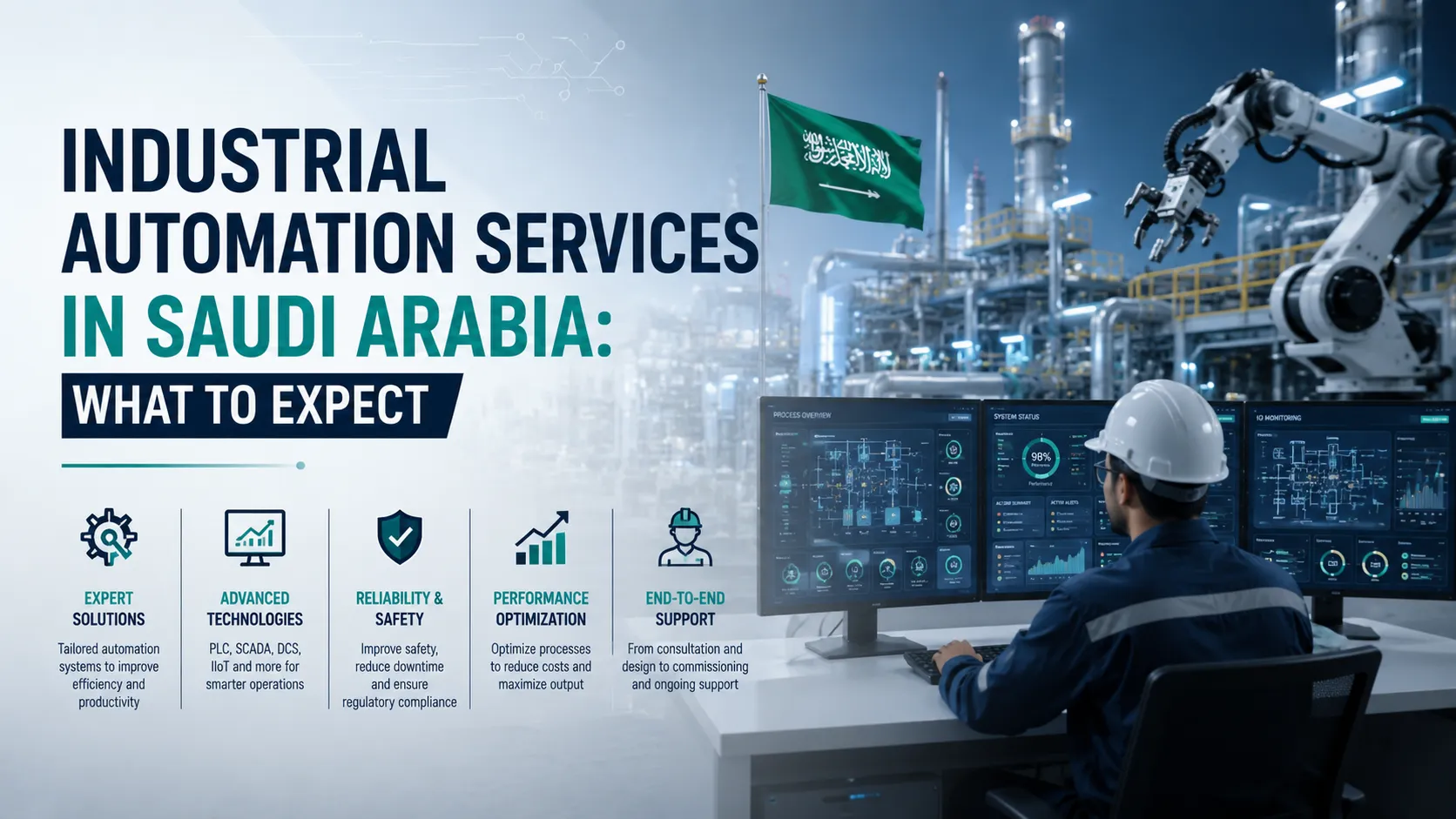
If you are evaluating automation for your plant or facility in Saudi Arabia, you have probably encountered a long list of services from different vendors with very little explanation of what each one actually involves. PLC programming, SCADA integration, panel building, and instrumentation are not interchangeable terms. They are distinct disciplines, and understanding what each covers helps you ask the right questions before committing to a contractor.
This guide explains each core industrial automation service clearly: what it is, what it delivers, and what a well-executed project looks like. The GCC market is expanding rapidly under Vision 2030, and facilities across the Kingdom are upgrading legacy systems and building new ones. Knowing what to expect from industrial automation services in Saudi Arabia will help you evaluate proposals, scope your project accurately, and avoid costly misalignments.
PLC Programming and Control System Engineering
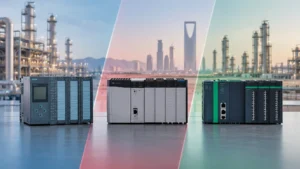
A PLC, or Programmable Logic Controller, is the brain of most industrial control systems. It reads inputs from sensors and field devices, executes logic, and sends outputs to actuators, motors, valves, and drives. PLC programming is the process of writing, testing, and documenting that logic to match your process requirements.
In Saudi Arabia, the most widely deployed PLC platforms include Siemens S7-1200 and S7-1500 series, Rockwell Automation ControlLogix and CompactLogix, and Schneider Electric Modicon. Each has its own programming environment and architecture, and the right choice depends on your I/O count, redundancy requirements, communication protocols, and existing plant infrastructure.
PLC programming as a service covers several deliverables:
- Functional Design Specification (FDS): documents exactly what the control system must do before a single line of code is written
- Software development in IEC 61131-3 compliant environments, covering ladder logic, function block diagrams, and structured text
- Factory Acceptance Testing (FAT): verifying the program against the FDS before equipment leaves the workshop
- Site commissioning and loop testing: confirming the system works correctly in your actual operating environment
- As-built documentation and software backup
A poorly scoped PLC project often lacks a formal FDS, which means the program is written based on verbal instructions and informal assumptions. When the commissioning engineer arrives on site, half the logic needs rework. Insist on a documented FDS before programming begins.
Redundancy and Failsafe PLC Systems
For critical processes, standard PLC configurations carry too much risk. A single CPU failure can halt production or, in a safety-critical application, create a hazardous condition. Redundant PLC architectures use dual CPUs, dual communication modules, and dual power supplies that operate in parallel and switch automatically on fault detection, typically within milliseconds.
In upstream oil and gas facilities across the Eastern Province and Jubail, redundant PLC systems are specified as standard for applications like compressor control, emergency shutdown coordination, and custody transfer metering. Siemens S7-400H and Rockwell Automation GuardLogix are common platforms for these applications. The engineering complexity is significantly higher, and commissioning timelines extend accordingly.
SCADA Systems and HMI Development
SCADA stands for Supervisory Control and Data Acquisition. It is the software layer that sits above the PLCs and field devices, giving operators a visual overview of the entire process, the ability to issue commands, and access to historical data and alarms.
A well-designed SCADA system does not just display data. It presents information in a way that helps operators make faster, better decisions. Alarm management, trend analysis, historian integration, and role-based access control are all part of a properly engineered SCADA implementation.
Common SCADA platforms used across Saudi Arabia’s industrial sector include Copa-Data Zenon, Wonderware (now AVEVA System Platform), Ignition by Inductive Automation, and Siemens WinCC. Platform selection should be driven by your process complexity, the number of I/O points, reporting requirements, and whether you need integration with ERP systems like SAP.
HMI, or Human Machine Interface, refers to the local operator panels installed at or near field equipment. These are separate from the central SCADA but follow the same display philosophy. ISA-101 is the international standard governing HMI design, and following it reduces operator error and improves response time during abnormal situations.
SCADA projects delivered without a proper alarm philosophy document produce systems with hundreds of nuisance alarms that operators learn to ignore. That is not automation; that is noise. A well-scoped SCADA engagement includes alarm rationalization as a defined deliverable.
SCADA Cybersecurity and IEC 62443
SCADA systems connected to corporate networks or the internet introduce cybersecurity risk into your operational technology environment. IEC 62443 is the international standard that defines security requirements for industrial automation and control systems, covering network segmentation, access control, patch management, and incident response.
In Saudi Arabia, facilities operating under Saudi Aramco’s cybersecurity framework or aligned with the National Cybersecurity Authority (NCA) guidelines are increasingly required to demonstrate IEC 62443 compliance. This means your SCADA architecture must define security zones and conduits, restrict external access, and log all user activity. Any automation partner delivering SCADA services should address cybersecurity architecture as part of the design, not as an afterthought.
Electrical Panel Building and MCC Design
Control panels and Motor Control Centres (MCCs) are the physical enclosures that house the electrical and control equipment connecting your PLC and field devices. Panel building is a specialist discipline that combines electrical engineering, component selection, mechanical design, and compliance testing.
In Saudi Arabia, control panels must meet IEC 61439, the international standard for low-voltage switchgear and control gear assemblies. This covers everything from busbar sizing and fault current ratings to temperature rise testing and documentation requirements. A panel built without IEC 61439 compliance is both a safety risk and a liability when it comes to client audits and insurance assessments.
For facilities in hazardous classified areas, panels must also meet ATEX or IECEx requirements, specifying which equipment can be installed in Zone 1 or Zone 2 environments. Getting this wrong is not just an engineering failure; it is a regulatory and safety violation.
What a professional panel build service delivers:
- Schematic design and engineering drawings in AutoCAD Electrical or EPLAN
- Component selection from approved vendor lists, including Schneider Electric, ABB, and Siemens breakers, contactors, and protection relays
- Physical fabrication, cable ferrule labelling, and internal wiring
- Type testing or routine testing per IEC 61439
- FAT witnessed by the client or a third-party inspector
- Full documentation pack: schematic drawings, cable schedules, equipment datasheets, test records
Integrated Motor Control Centres for Large Facilities
An MCC is a centralised enclosure containing multiple motor starters, variable frequency drives (VFDs), protection relays, and associated control equipment. For large plants with dozens of motors, a well-designed MCC reduces panel footprint, simplifies maintenance access, and provides a single point of testing and documentation.
In water treatment facilities, manufacturing plants, and utilities across the GCC, MCCs are increasingly specified with intelligent motor management relays that communicate over Modbus or PROFIBUS to the plant SCADA. This allows remote start/stop commands, real-time current monitoring, and fault logging without the need for additional hardwiring. The engineering upfront is more complex, but the operational benefit over the plant lifetime is significant.
Field Instrumentation and Process Measurement
Instrumentation refers to the sensors and transmitters that measure process variables: flow, pressure, temperature, level, and analytical parameters like pH or conductivity. Without accurate, reliable instrumentation, no automation system can function correctly, regardless of how well the PLC logic or SCADA is engineered.
Instrumentation services cover selection, procurement, calibration, installation, and loop testing of field instruments. In Saudi Arabia’s oil and gas, water, and chemical sectors, common instrument suppliers include Endress+Hauser, Emerson, Yokogawa, and ABB. Selection criteria include process compatibility, hazardous area certification, communication protocol (HART, PROFIBUS PA, or Foundation Fieldbus), and maintenance requirements.
A recurring issue on poorly managed projects is instrument datasheets that are approved late, leading to procurement delays that push the entire commissioning schedule back by weeks. The instrumentation scope should be fully defined and datasheets approved before procurement begins.
Loop documentation is another deliverable that is often underestimated. Each instrument loop requires a loop diagram showing the field device, junction box wiring, cable routing, and control room termination. For facilities under Saudi Aramco or SABIC governance, loop diagrams are auditable documents. Incomplete or inaccurate loop documentation is one of the most common causes of commissioning delays in the KSA market.
HART and Fieldbus Communication Protocols
HART (Highway Addressable Remote Transducer) is the most widely used digital communication protocol for field instruments in Saudi Arabia. It allows a 4 to 20 mA analog signal and a digital signal to travel on the same cable simultaneously, meaning operators can read process values and diagnostic data from the same transmitter without additional wiring.
PROFIBUS PA and Foundation Fieldbus are fully digital alternatives used in larger, more complex systems where diagnostics, multi-variable measurement, and device configuration from the control room are required. These protocols add engineering complexity but reduce cabling costs significantly on large sites. A competent instrumentation engineer should be able to specify the right protocol for your application rather than defaulting to whatever they are most familiar with.
System Integration and Vision 2030 Alignment
The five service areas above, PLC programming, SCADA, panel building, instrumentation, and networking, do not function in isolation. System integration is the discipline of making all these components communicate reliably, exchange data accurately, and operate as a unified control architecture.
Saudi Arabia’s Vision 2030 program is driving investment in industrial digitalization across sectors that historically relied on manual processes and legacy control systems. Facilities across Jubail, Yanbu, Riyadh, and Dammam are upgrading to connected, data-driven operations that feed real-time information into management dashboards and enterprise systems. This shift requires more than hardware replacement; it requires a system integration partner who understands both the operational technology (OT) layer and the information technology (IT) layer.
OT/IT convergence is one of the most significant engineering challenges facing Saudi industrial facilities right now. Connecting a plant SCADA system to a corporate ERP like SAP requires careful protocol translation, data mapping, and cybersecurity controls to prevent IT network threats from reaching the control system. Moxa industrial routers and switches are commonly used for secure network segmentation at the OT/IT boundary.
For greenfield projects, integration planning should begin at the conceptual engineering stage, not after panels are already being built. For brownfield upgrades, a thorough site survey of existing control systems, communication protocols, and network topology is the mandatory starting point.
Frequently Asked Questions
Here are answers to the most common questions about industrial automation services in Saudi Arabia.
What is included in industrial automation services in Saudi Arabia?
Industrial automation services typically include PLC programming and control system engineering, SCADA and HMI development, electrical panel building and MCC design, field instrumentation selection and installation, and system integration. Some providers also offer cybersecurity assessment, remote monitoring, and post-commissioning maintenance contracts. The specific scope depends on whether you are building a new facility, upgrading an existing system, or adding automation to a previously manual process.
How long does an industrial automation project take in Saudi Arabia?
Project timelines vary significantly based on scope. A single control panel with PLC and SCADA can be delivered in 10 to 14 weeks from design to FAT. A full plant automation project covering multiple systems, instrumentation, and system integration typically takes 6 to 18 months from contract award to commissioning handover. The most common causes of delays are late instrument datasheets, changes to scope after engineering is complete, and insufficient time allocated for FAT.
What is the difference between PLC and SCADA in industrial automation?
A PLC (Programmable Logic Controller) executes the control logic at the field level, reading sensor inputs and sending outputs to actuators. A SCADA (Supervisory Control and Data Acquisition) system sits above the PLC and gives operators a visual overview of the process, alarm management, and historical data. PLCs control the process; SCADA monitors and supervises it. Both are required in most modern industrial automation systems and must be engineered to communicate reliably with each other.
Do industrial automation systems in Saudi Arabia need to meet specific standards?
Yes. IEC 61439 applies to electrical panels and MCCs. IEC 61131-3 governs PLC programming environments. IEC 62443 applies to cybersecurity of industrial control systems. ATEX and IECEx apply to equipment installed in hazardous classified areas. For projects under Saudi Aramco or SABIC governance, client-specific engineering standards and documentation requirements also apply. A competent automation partner should be familiar with all of these and apply them without being asked.
How do I know if an automation company in Saudi Arabia can handle my project?
Ask for case studies from projects of similar size and complexity in your industry. Verify that the company has local engineers permanently based in Saudi Arabia, not just a regional sales office. Confirm they hold ISO 9001 certification and have brand-specific engineering credentials for the platforms they will use. Ask specifically who will lead the engineering, not just who will manage the account. A company that can answer all of these questions clearly and quickly has the structure to deliver.
Conclusion
Industrial automation services in Saudi Arabia span a wide range of disciplines: PLC engineering, SCADA development, panel building, instrumentation, and system integration. Each service has defined deliverables, applicable standards, and common pitfalls that a well-prepared client should understand before engaging a contractor.
The clearest differentiator between a capable automation partner and a hardware supplier is whether they apply engineering rigour at every stage, from functional design through FAT and commissioning.
SAS Technology delivers all of these services from its base in Al Khobar, with local engineers, multi-brand expertise, and completed projects across Saudi Arabia’s most demanding industrial sectors.
For industrial automation solutions across Saudi Arabia, Bahrain, and Oman, contact SAS Technology today.