EPC contractors and electrical engineers in Saudi Arabia face the same recurring problem: specifying or procuring a low voltage panel that meets project standards, passes inspection, and does not cause delays during commissioning. With dozens of local fabricators and international suppliers competing for the same contracts, choosing the right LV panel manufacturer in Saudi Arabia is not straightforward.
This guide cuts through the noise. You will learn the difference between panel types, which IEC standards govern LV switchgear in KSA, what local fabrication gets right and where it falls short, and the exact questions to ask a manufacturer before placing an order. Engineers and procurement managers will both find this useful.
What Is an LV Panel and Why Does Specification Matter in Saudi Arabia
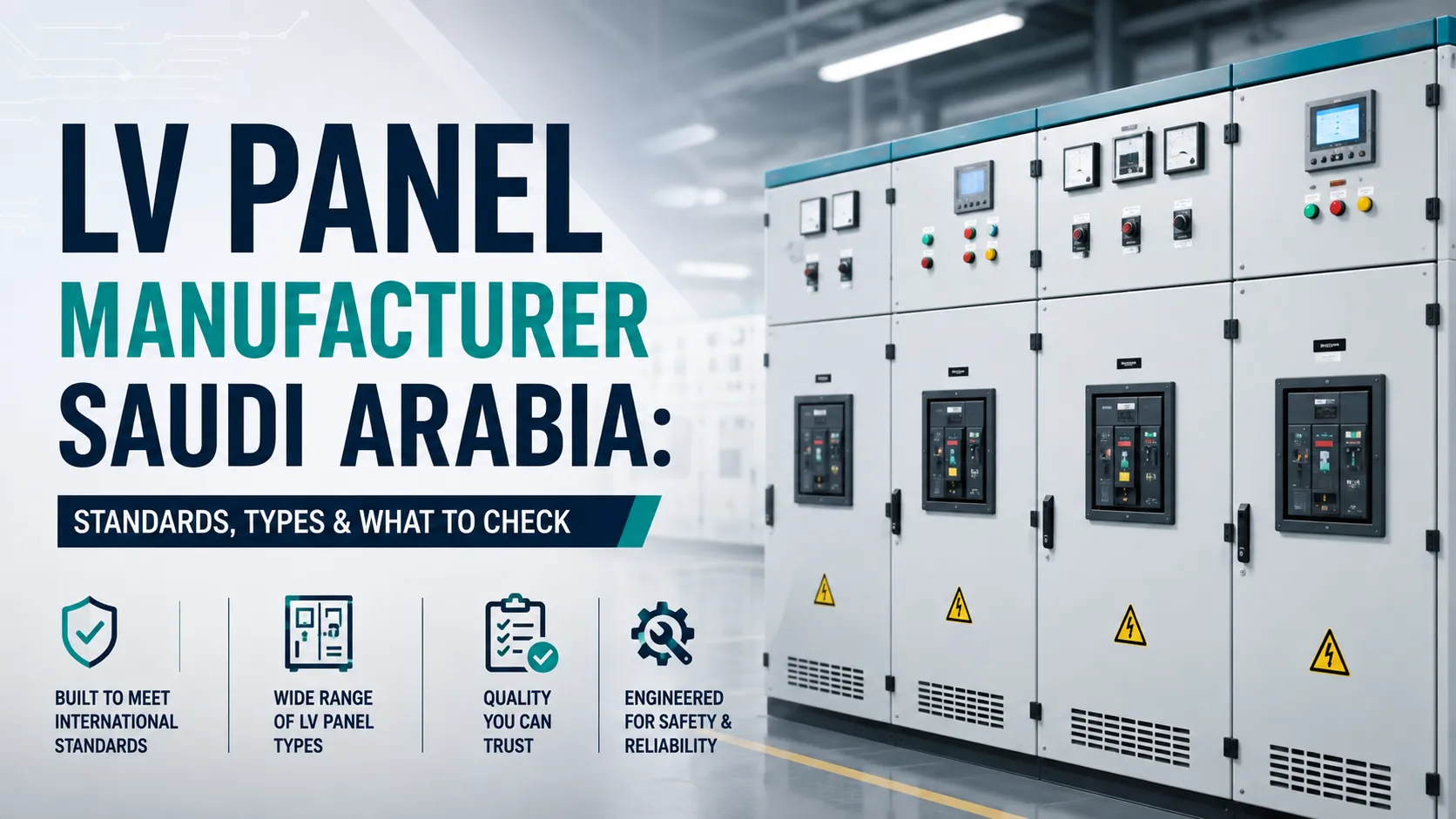
A low voltage (LV) panel is an electrical enclosure that houses switching, protection, and control equipment operating at voltages up to 1,000V AC or 1,500V DC. In Saudi Arabia, LV panels are the backbone of power distribution across oil and gas facilities, industrial plants, commercial towers, hospitals, and water treatment stations.
The specification matters because a poorly built panel creates cascading problems: nuisance tripping, overheating, arc flash events, and failed SAGIA or SABIC project audits. Saudi Aramco, one of the region’s most demanding end-users, enforces its own engineering standards on top of international requirements, which means a panel that passes a generic factory test may still fail a client witness test on a project in the Eastern Province.
Saudi Vision 2030 has accelerated industrial development across the Kingdom, driving demand for LV switchgear in new manufacturing zones, logistics hubs, and smart city infrastructure projects. This demand has attracted both serious manufacturers and low-quality assemblers. Knowing the difference between the two protects your project schedule and your professional reputation.
The governing international standard for LV switchgear assemblies is IEC 61439, which replaced the older IEC 60439 series. Any LV panel manufacturer in Saudi Arabia supplying to a serious EPC contractor or end-user must demonstrate IEC 61439 compliance.
How IEC 61439 Applies to LV Panel Manufacturing
IEC 61439 defines the design verification and routine verification requirements for low voltage switchgear and controlgear assemblies. Design verification confirms the panel’s design meets the standard through type testing or verified calculations. Routine verification checks every individual panel unit as it leaves the factory.
Part 1 covers general rules. Part 2 covers power switchgear assemblies (PDB, MDB, SMDB). Part 3 covers distribution boards. Part 5 covers public network distribution assemblies. A manufacturer who cannot produce a valid IEC 61439 type test report from an accredited laboratory should not be on your vendor list for any project in the GCC.
Types of LV Panels Used in Saudi Arabia Projects
LV panels are not all the same. Different applications call for different panel types, and confusing them during the design phase creates specification errors that are expensive to correct on site.
Main Distribution Board (MDB): Receives power from the transformer or generator and distributes it to downstream panels. Typically houses ACBs (Air Circuit Breakers) or large MCCBs. Found in substations and main plant rooms.
Sub Main Distribution Board (SMDB): Sits between the MDB and final distribution boards. Distributes power to a defined zone or floor within a building or facility.
Final Distribution Board (FDB): Feeds individual circuits directly. Typically houses MCBs and RCDs. Common in residential, commercial, and light industrial applications.
Motor Control Centre (MCC): Controls and protects multiple motor circuits from a single enclosure. MCCs combine starters, variable frequency drives (VFDs), protection relays, and manual isolation in a structured, withdrawable or fixed configuration.
Power Factor Correction (PFC) Panel: Contains capacitor banks and associated switching equipment to improve the facility’s power factor, reducing reactive power charges from the utility. In Saudi Arabia, SEC (Saudi Electricity Company) enforces power factor penalties on commercial and industrial consumers.
Automatic Transfer Switch (ATS) Panel: Manages automatic changeover between mains power and a standby generator. Critical for hospitals, data centers, and process plants where supply continuity is non-negotiable.
MCC vs Standard LV Distribution Panel: Key Differences
An MCC and a standard LV distribution panel are frequently confused in project specifications, particularly by clients new to industrial projects. The core difference is function. A distribution panel manages power flow. An MCC manages motor loads, which means it must handle inrush currents, provide motor protection relay functions, and often interface with a control system via hardwired I/O or fieldbus communication.
MCCs built for Saudi petrochemical or industrial projects commonly integrate ABB or Siemens motor protection relays, Schneider Electric variable speed drives, and communication modules using Profibus or Modbus TCP. IEC 61439-1 governs the assembly, while individual components must meet IEC 60947 series standards for industrial switchgear.
Local LV Panel Fabrication vs Imported Switchgear in Saudi Arabia
The choice between locally fabricated LV panels and imported type-tested switchgear assemblies is one of the most debated procurement decisions on Saudi industrial projects. Both have legitimate use cases, and the right answer depends on project requirements, timeline, and budget.
Locally fabricated panels offer faster delivery for standard applications, easier post-delivery modification, and lower unit cost. Many competent fabricators operate in the Eastern Province, Riyadh, and Jeddah industrial areas. However, fabrication quality varies significantly. The key risk with local fabrication is incomplete design verification under IEC 61439. Some fabricators rely on component manufacturer type test reports without performing system-level verification, which is not fully compliant.
Imported type-tested assemblies from manufacturers like Schneider Electric (Prisma or Okken range), ABB (MNS or UniGear), or Siemens (SIVACON) arrive with complete IEC 61439 design verification documentation and are manufactured under controlled factory conditions. The trade-off is lead time, which can run 12 to 20 weeks for customized configurations, and higher procurement cost.
For projects with strict Aramco or SABIC vendor approval requirements, imported type-tested switchgear is often the only compliant path. For standard commercial or light industrial applications in KSA, a well-qualified local fabricator can deliver a cost-effective and compliant solution.
What Vision 2030 Means for Local LV Panel Manufacturing
Saudi Vision 2030’s local content program (Iktva in the energy sector, NUSANED more broadly) actively incentivizes in-Kingdom manufacturing of industrial equipment, including LV switchgear. Several international manufacturers have established or expanded local assembly operations in Saudi Arabia in response, including partnerships in the Jubail and Riyadh industrial zones.
For EPC contractors and project owners, procuring from a locally licensed and manufactured source can improve Iktva scores and strengthen bids for government-backed projects. This has raised the quality bar for local LV panel fabricators, as they must now meet international standards while also satisfying local content audit requirements.
What to Verify Before Ordering from an LV Panel Manufacturer in Saudi Arabia
Whether you are procuring from a local fabricator or an international supplier’s local representative, the following checks are non-negotiable before placing an order.
IEC 61439 Type Test Reports: Request the actual test reports, not just a declaration of conformity. The reports should be from an accredited third-party laboratory such as KEMA, CESI, or MET Labs. Verify the tested configuration matches what you are ordering.
Factory Capability Assessment: Visit the fabrication facility or request a third-party audit. Check for calibrated busbar bending machines, copper conductor sizing tools, torque wrench records, and a documented quality management system. ISO 9001 certification is a basic expectation.
Material Certificates: Busbars must be manufactured from electrolytic copper with a minimum conductivity of 99.9%. Enclosure steel thickness should match the specified IP rating. Powder coating must meet salt spray test requirements for the facility’s environment, particularly for coastal sites near Jubail or along the Red Sea coast.
Software and Protection Coordination Study: A competent manufacturer will review your single-line diagram and flag coordination issues before fabrication begins. Protection relay settings should be documented and provided with the panel.
FAT (Factory Acceptance Test) Procedure: Confirm the FAT scope covers insulation resistance testing, primary injection testing for protection relays, operational sequence testing, and label verification. For Honeywell or Rockwell Automation integrated systems, functional I/O loop checks should be part of the FAT.
Busbar Sizing and Thermal Verification Under IEC 61439
Busbar sizing is one of the most technically critical elements of LV panel design and one of the most commonly under-engineered areas in low-cost fabrication. IEC 61439 requires that busbars be verified for temperature rise under rated current, short-circuit withstand strength, and creepage and clearance distances.
A 2,000A copper busbar system in a 40°C ambient environment (standard for Saudi Arabia facilities) behaves very differently from one rated in a 35°C European factory environment. Reputable manufacturers like ABB and Schneider Electric derate their busbar systems for Gulf ambient conditions.
A local fabricator must apply the same derating calculations and document them as part of the IEC 61439 design verification package. If they cannot produce this document, the panel is not IEC 61439 compliant regardless of what their quotation says.
Real-World Scenario: MCC Procurement for an Industrial Facility in Jubail
A process engineering contractor working on a utility expansion project in Jubail Industrial City required 14 MCC panels for new pump and compressor motor loads ranging from 7.5 kW to 315 kW. The client, a petrochemical producer, specified IEC 61439 compliance, Siemens SIMOCODE motor protection relays, and Profibus DP communication to an existing Siemens S7-400 PLC system.
The contractor initially approached three local fabricators. Only one could demonstrate a valid IEC 61439 Part 2 type test report for their MCC configuration and had prior experience with Profibus integration. The other two submitted competitive prices but could not produce the required design verification documentation.
The qualifying fabricator was awarded the contract. The project completed FAT within the scheduled window, and site commissioning required zero panel modifications, a direct result of accurate design verification and proper protection coordination completed before fabrication began. This outcome is not exceptional. It is what proper vendor qualification produces consistently.
Frequently Asked Questions
Here are answers to the most common questions about LV panel manufacturers in Saudi Arabia.
What standard governs LV panels in Saudi Arabia?
The primary standard for low voltage switchgear and controlgear assemblies in Saudi Arabia is IEC 61439, which replaced IEC 60439. It covers design verification and routine verification requirements for all LV panel types including MDBs, MCCs, and distribution boards. Saudi Aramco and SABIC projects also apply their own engineering standards on top of IEC 61439. SEC connection requirements add further conditions for panels interfacing with the national grid. Any credible LV panel manufacturer in Saudi Arabia must hold valid IEC 61439 type test reports from an accredited laboratory.
What is the difference between an MDB and an MCC panel?
An MDB (Main Distribution Board) distributes electrical power to downstream circuits and panels. An MCC (Motor Control Centre) specifically manages and protects motor loads, incorporating starters, variable frequency drives, and motor protection relays within a single structured assembly. MCCs are used in industrial and process environments. MDBs are used in both commercial and industrial power distribution. The two are governed by IEC 61439 but serve different functions and require different internal configurations.
How long does LV panel fabrication take in Saudi Arabia?
Lead times for locally fabricated LV panels in Saudi Arabia typically range from 6 to 14 weeks depending on panel complexity, component availability, and the fabricator’s current workload. Simple distribution boards can be ready in 4 to 6 weeks. Complex MCCs with integrated drives, protection relays, and communication modules require 10 to 16 weeks including FAT. Imported type-tested switchgear assemblies from international manufacturers carry longer lead times of 12 to 20 weeks. Always confirm component availability, particularly for circuit breakers and drives, before committing to a fabrication schedule.
Can a local Saudi fabricator meet Aramco panel standards?
Yes, but only if the fabricator holds the relevant Saudi Aramco vendor qualification and can demonstrate IEC 61439 design verification for their panel configurations. Aramco’s engineering standards (SAES series) impose requirements beyond IEC 61439 in areas such as enclosure ratings, labeling, arc flash protection, and documentation. Fabricators without Aramco approval on their vendor list cannot supply directly to Aramco projects. Some EPC contractors source from Aramco-approved international manufacturers for critical panels and use local fabricators only for ancillary boards.
What should I check during a panel FAT in Saudi Arabia?
A comprehensive Factory Acceptance Test for an LV panel should include: insulation resistance testing of all circuits, primary injection testing to verify protection relay operation at set current values, functional operation of all switching devices, verification of all labels against the single-line diagram, continuity testing of earth connections, and operational sequence testing of interlocks and control circuits. For MCCs with VFDs or PLC integration, I/O loop checks should confirm correct signal transmission between the panel and the control system. All test results should be documented and signed by both manufacturer and client representatives.
Conclusion
Specifying and procuring the right LV panel for a Saudi Arabia project comes down to three things: confirming IEC 61439 compliance with real type test documentation, selecting the panel type that matches your actual application, and qualifying your manufacturer before fabrication begins, not after problems appear on site.
Whether you choose a local fabricator in the Eastern Province or an imported solution, the verification process is the same. Cutting corners at the procurement stage creates commissioning delays and safety risks that cost far more than the savings. For industrial automation solutions across Saudi Arabia, Bahrain, and Oman, contact SAS Technology today.