Many procurement managers and plant engineers across the GCC face the same challenge: dozens of vendors claim to offer industrial automation services, but only a handful can actually deliver a reliable, scalable solution. In Saudi Arabia, where Vision 2030 is driving massive industrial expansion across petrochemicals, utilities, and manufacturing, choosing the wrong automation partner can delay projects by months and cost millions in rework.
This guide breaks down exactly what to evaluate when selecting an industrial automation company in Saudi Arabia. You will learn which certifications matter, why multi-brand expertise is critical, what local support actually means, and how to assess real project experience before signing any contract.
Why the Right Industrial Automation Company Changes Everything
Industrial automation is not a commodity purchase. A PLC panel bought off a shelf is not the same as a fully engineered control system that integrates with your SCADA, communicates over IEC 61850 protocols, and meets your specific process safety requirements. The right partner brings engineering discipline, not just equipment supply.
Saudi Arabia’s industrial sector is one of the most demanding environments in the world. Sites in Jubail Industrial City, Yanbu, and the Eastern Province operate under extreme temperatures, high humidity, and strict HSE requirements aligned with both local SASO standards and international frameworks like ATEX for hazardous area classification.
A competent industrial automation company in Saudi Arabia must understand these realities from day one. They should not need to ask basic questions about your operating environment. They should already know it.
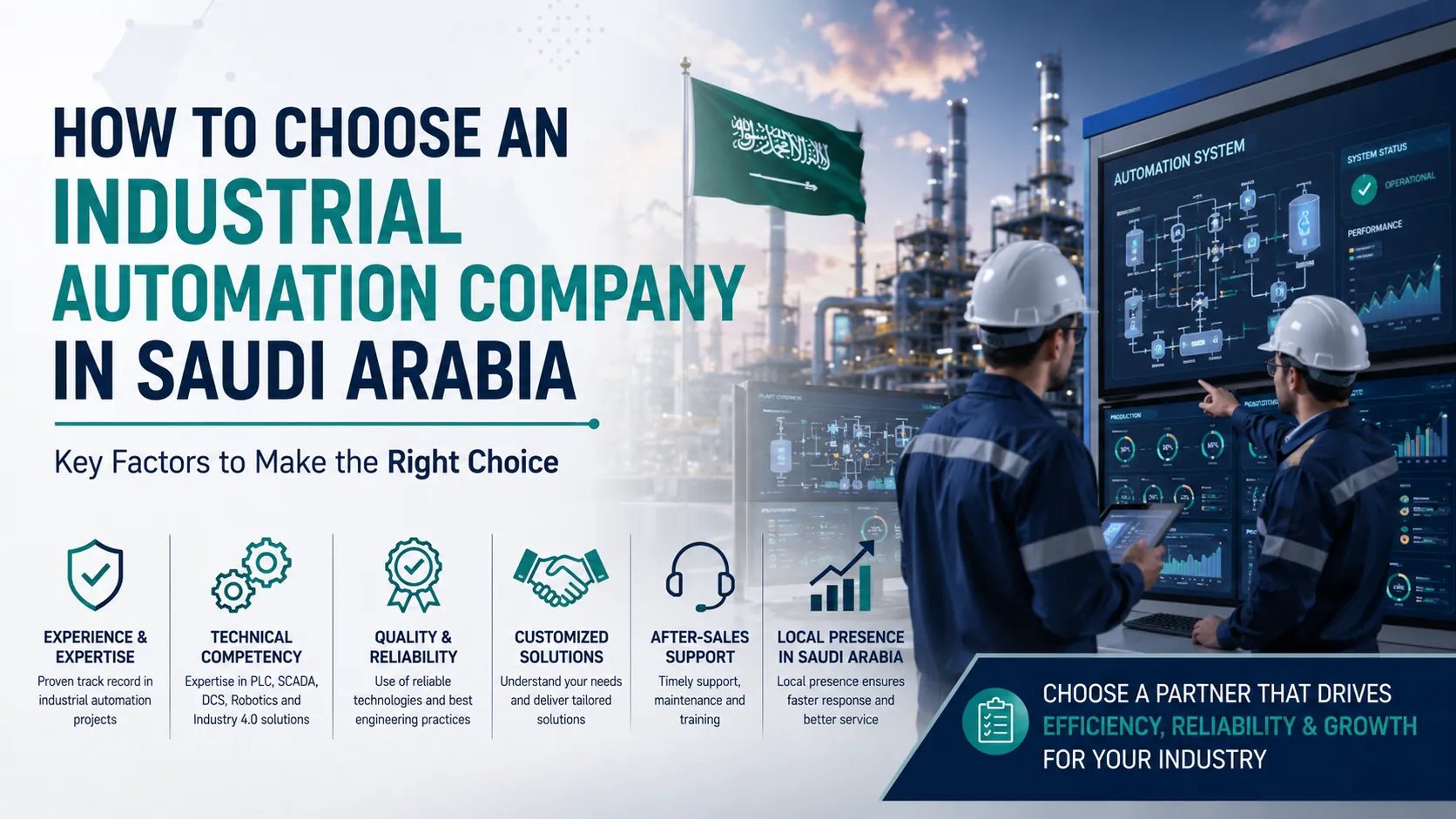
Key factors that separate capable automation partners from vendors:
- Engineering depth: Can they design from scratch, not just install pre-configured systems?
- Standards knowledge: Do they actively reference IEC 62443 for cybersecurity, IEC 61131-3 for PLC programming, and ATEX where hazardous zones apply?
- Brand portfolio: Do they work with multiple OEMs or are they locked to one supplier’s ecosystem?
- Local presence: Do they have engineers physically based in Saudi Arabia or do they fly in for every service call?
- Track record: Can they reference completed projects in your industry, not just sales brochures?
What “Turnkey Automation” Really Means in Saudi Arabia
The term “turnkey” is overused. In the Saudi market, a genuine turnkey automation project means the contractor takes responsibility from conceptual design all the way through FAT (Factory Acceptance Testing), SAT (Site Acceptance Testing), commissioning, and handover with full documentation.
Any company that calls itself turnkey but subcontracts engineering, FAT testing, or SCADA configuration to third parties is not truly turnkey. Ask explicitly: who will execute each phase, and where are those engineers based? For projects tied to Saudi Aramco, SABIC, or SEC frameworks, documentation quality and traceability are auditable requirements, not preferences.
Certifications and Standards: The Non-Negotiable Checklist
Certifications are not marketing badges. They are evidence that the company has been evaluated by an independent body against a defined technical standard. When assessing an industrial automation company in Saudi Arabia, verify the following before anything else.
ISO 9001 certification confirms a quality management system is in place, meaning engineering outputs, testing procedures, and delivery processes follow documented controls. Without this, quality is entirely dependent on individual engineers, which creates project risk.
For electrical panel builders and system integrators, IEC 61439 compliance is the standard governing low-voltage switchgear and control gear assemblies. Any MCC, PDB, or control panel being designed for your facility should be built and tested in accordance with this standard.
If your facility falls under hazardous area classifications, ATEX and IECEx certified equipment and engineering practices are mandatory, not optional. Companies operating in upstream oil and gas, petrochemical, or fertilizer plants in the Eastern Province should verify that their automation partner has documented experience with Zone 1 and Zone 2 classified areas.
Why Multi-Brand Expertise Matters More Than You Think
A company that only works with one brand, whether that is Siemens, ABB, or Schneider Electric, will always recommend that brand regardless of whether it is the best fit for your application. That is not engineering; it is sales.
Genuine multi-brand integrators can benchmark hardware and software across platforms, select the right PLC family for your I/O count and redundancy requirements, choose the SCADA platform (such as Copa-Data Zenon, Wonderware, or Ignition) based on your reporting and historian needs, and recommend Endress+Hauser or equivalent instrumentation based on process compatibility. This independence is one of the most valuable things an automation partner can offer.
Local Support and After-Sales Service in the Saudi Market
Industrial plants do not schedule breakdowns. When a critical control loop fails at 2 AM on a Friday in Jubail, you need an engineer on-site within hours, not on a flight from Europe the next morning. Local support capability is one of the most underweighted criteria in vendor selection, and it is often the factor that determines whether a long-term relationship develops or collapses after the first emergency.
When evaluating local support, ask specific questions rather than accepting general assurances. How many engineers are permanently based in Saudi Arabia? What is the guaranteed response time for a critical fault call? Do they carry commonly used spare parts (drives, I/O cards, HMI panels) in-country? Is there a support contract structure with defined SLA tiers?
Companies that truly support the Saudi market will maintain a warehouse of critical spares, offer remote monitoring services, and have local engineers trained on the brands they supply. Moxa industrial networking equipment, for example, requires configuration expertise that cannot be delegated to a general electrician. The same applies to Rockwell Automation ControlLogix systems, which have their own architecture, programming environment, and fault diagnostics.
Response Time Benchmarks to Expect from Your Automation Partner
A well-structured SLA (Service Level Agreement) for industrial automation support in Saudi Arabia should include at minimum three response tiers: critical fault response within 4 hours for process-critical failures, urgent support within 24 hours for non-critical faults affecting production efficiency, and standard support within 72 hours for planned maintenance or minor issues.
Companies offering only next-day response for critical faults are not structured to support production-critical environments. If you are operating a continuous process plant, any downtime that exceeds 4 to 6 hours carries significant financial and operational consequences. Make your SLA requirements clear before contract award, not after.
Project Experience: How to Evaluate a Track Record That Is Real
Every automation company in Saudi Arabia will show you a project list. The question is how to read it critically. A list of logos is not evidence of delivered capability. A completed project in your specific industry, with documented scope, timeline, and outcome, is.
Ask for case studies that describe the specific technical challenge, the engineering approach taken, the standards applied, and the final commissioning outcome. Ask whether the project was delivered on schedule and what deviations occurred. Ask for references from the end client or EPC contractor who managed that project.
For greenfield projects in the KSA market, experience with Saudi Aramco SAEP procedures, SABIC technical standards, or SEC engineering codes is a significant differentiator. These clients have highly specific documentation and testing requirements that only companies with prior experience can navigate efficiently. A first-time vendor learning your client’s requirements on your project is a risk you should not accept.
One real-world example: a petrochemical facility in Jubail Industrial City selected an automation partner based primarily on price. The vendor lacked experience with Aramco’s instrument loop documentation requirements, which resulted in a 14-week delay to the commissioning phase while documentation was redone from scratch. The cost of that delay far exceeded the initial savings on the contract value.
What to Look for in a System Integrator’s Engineering Team
The quality of an automation project is ultimately determined by the engineers executing it. When evaluating a systems integrator, ask to meet the project team, not just the sales director. Review the CVs of the lead automation engineer and controls engineer who will actually work on your project.
Relevant qualifications to look for include CSIA (Control System Integrators Association) membership or certification, professional engineering licenses, brand-specific certifications from Siemens (SIMATIC), Schneider Electric (EcoStruxure), or Honeywell (Experion), and documented experience with functional safety standards such as IEC 61511 for process industries. Companies whose senior engineers hold these credentials are investing in engineering quality, not just headcount.
How SAS Technology Meets These Criteria in Saudi Arabia
SAS Technology, headquartered in Al Khobar in the Eastern Province, has been delivering industrial automation solutions across Saudi Arabia, Bahrain, and Oman for over two decades. The company operates as a multi-brand integrator with engineering capabilities across Siemens, ABB, Schneider Electric, Rockwell Automation, and Copa-Data Zenon platforms.
SAS Technology holds ISO 9001 certification and maintains a local engineering team permanently based in Saudi Arabia, with dedicated support engineers and a local spares holding for rapid fault response. The company has delivered projects across upstream and downstream oil and gas, water and wastewater, power distribution, and manufacturing sectors, including projects governed by Saudi Aramco and SABIC engineering standards.
The company offers complete turnkey automation services: from conceptual engineering and panel design through FAT, site commissioning, and post-commissioning support contracts. All panel designs are built to IEC 61439 and ATEX requirements where applicable, and SCADA and MES implementations reference IEC 62443 cybersecurity frameworks for network segmentation and access control.
For Vision 2030-aligned industrial projects requiring a technically capable, locally supported, and multi-brand automation partner, SAS Technology is structured to deliver from day one.
Frequently Asked Questions
Here are answers to the most common questions about choosing an industrial automation company in Saudi Arabia.
What certifications should an industrial automation company in Saudi Arabia have?
At minimum, look for ISO 9001 (quality management), IEC 61439 compliance for panel building, and ATEX or IECEx experience if your facility includes hazardous classified areas. If the project involves cybersecurity requirements, the company should also reference IEC 62443. For projects under Saudi Aramco or SABIC, ask whether the company has prior experience with those clients’ specific engineering standards and approval processes.
How do I verify that an automation company has genuine project experience in Saudi Arabia?
Request detailed case studies rather than logo lists. Ask for the project scope, the standards applied, the commissioning outcome, and a client reference. For KSA-specific projects, ask whether the company has experience with Aramco SAEP procedures, SABIC technical standards, or SEC engineering codes. A company with genuine Saudi market experience will answer these questions precisely, without hesitation.
What is the difference between an automation vendor and a system integrator?
A vendor supplies hardware and software products. A system integrator designs, engineers, programs, installs, and commissions a complete automation solution, often using products from multiple vendors. For complex industrial applications, you need a system integrator, not just a supplier. The integrator takes responsibility for how the entire system functions together, including PLC logic, SCADA communication, network architecture, and safety interlocks.
How important is local support when choosing an automation partner in Saudi Arabia?
Local support is critical for production-critical environments. When a fault occurs in a continuous process plant, every hour of downtime has a measurable cost. An automation partner without local engineers and local spare parts cannot meet the response time requirements that production operations demand. Look for companies with permanently based engineers in Saudi Arabia and a defined SLA with specific response time commitments for critical, urgent, and standard fault categories.
Which automation brands are most commonly used in Saudi Arabia’s oil and gas sector?
Siemens, ABB, Schneider Electric, Rockwell Automation, and Honeywell are the most widely deployed automation platforms in Saudi Arabia’s oil and gas and petrochemical industries. Instrumentation suppliers such as Endress+Hauser and Emerson are common for flow, pressure, and level measurement. Industrial networking infrastructure often uses Moxa or Cisco hardware. A capable system integrator should be able to work across all of these platforms, not just one.
Conclusion
Selecting an industrial automation company in Saudi Arabia comes down to three things: verified technical capability, genuine local presence, and a proven track record in your industry. Certifications like ISO 9001, IEC 61439 compliance, and ATEX experience set the baseline.
Multi-brand engineering expertise ensures you get the right solution, not just the brand the vendor is incentivized to sell. Local support with defined SLAs ensures you are not left exposed when a fault occurs.
SAS Technology meets all of these criteria with a permanent engineering team in Al Khobar, multi-brand integration capability, and two decades of completed projects across Saudi Arabia’s most demanding industrial sectors.
For industrial automation solutions across Saudi Arabia, Bahrain, and Oman, contact SAS Technology today.