
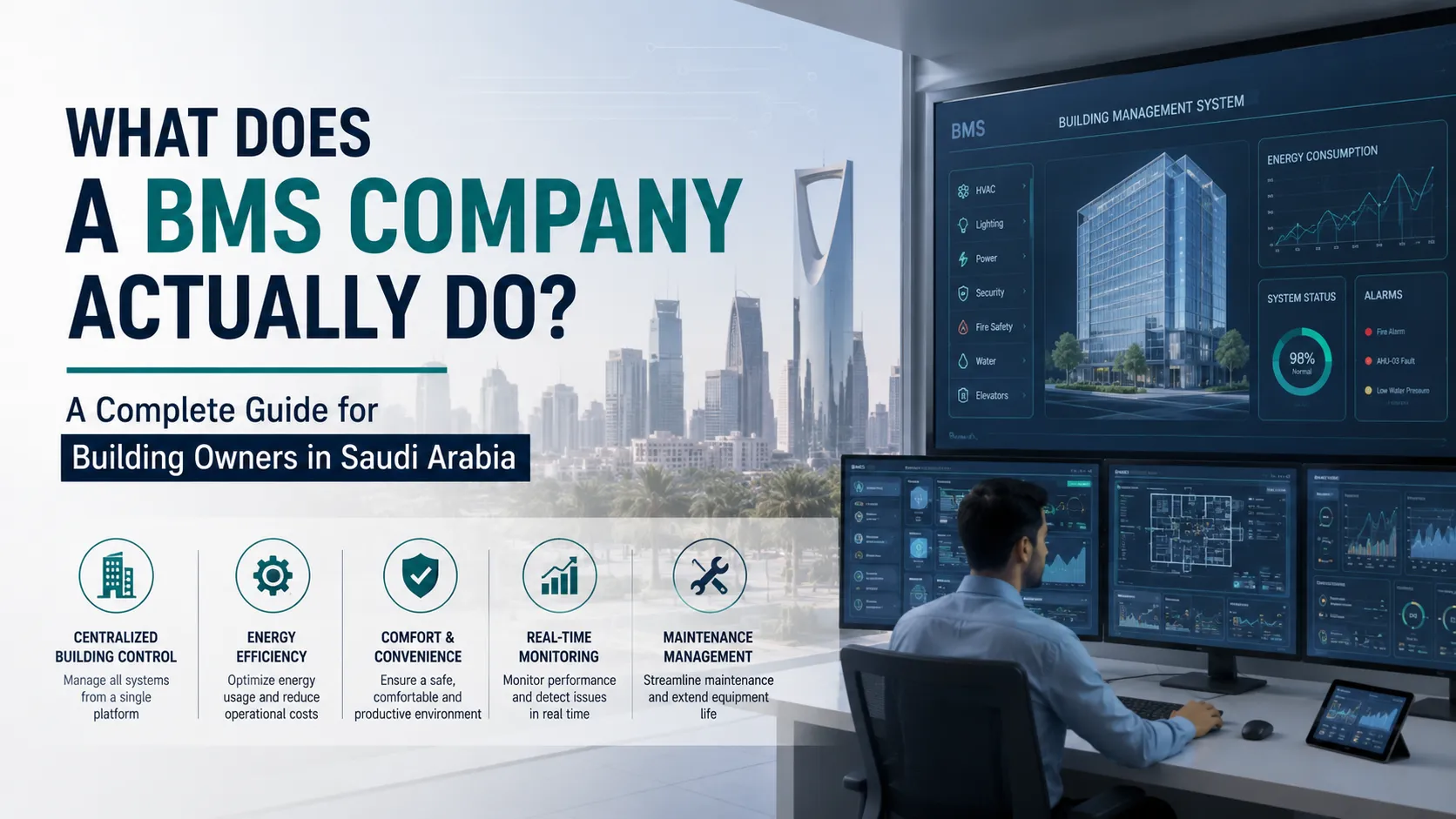
If you own or manage a commercial building in Riyadh, Jeddah, or the Eastern Province, you have likely heard the term BMS thrown around by contractors and consultants. But what does a BMS company actually deliver, and is the investment worth it for your facility? This guide answers both questions directly.
You will learn what a Building Management System is, how it works inside real Saudi buildings, what a qualified BMS company does from design to commissioning, how much energy you can realistically save, and what to look for when choosing a BMS partner in the GCC. No jargon left unexplained.
What Is a Building Management System and Why Do Saudi Buildings Need One
A Building Management System (BMS), sometimes called a Building Automation System (BAS), is a centralized software and hardware platform that monitors and controls a building’s mechanical and electrical systems from a single interface. This includes HVAC, lighting, fire alarms, access control, elevators, and power distribution.
In Saudi Arabia, where outdoor temperatures regularly exceed 45°C and cooling loads account for up to 70% of a commercial building’s total energy consumption, an unmanaged building wastes significant resources every single day. Without a BMS, facility managers rely on manual checks, fragmented controls, and reactive maintenance. Equipment runs longer than needed. Faults go undetected for hours. Energy bills stay permanently high.
Saudi Vision 2030 has placed energy efficiency at the center of the Kingdom’s sustainability roadmap. The Saudi Energy Efficiency Center (SEEC) has introduced mandatory efficiency standards for commercial buildings, and ASHRAE 90.1 compliance is increasingly required on large projects. A BMS is the primary tool that helps building owners meet those standards while reducing operational costs simultaneously.
For new developments in areas like King Abdullah Economic City, NEOM, and the commercial districts of Riyadh, a BMS is no longer optional. It is a baseline requirement for smart, compliant, and cost-efficient operations.
The Core Systems a BMS Controls
A BMS integrates multiple building systems through a common communication backbone, typically using open protocols such as BACnet, Modbus, or KNX. Controllers from manufacturers like Siemens and Schneider Electric sit at the field level, reading sensor data and executing commands from the central supervisory platform.
At minimum, a BMS in a Saudi commercial building will control HVAC setpoints and scheduling, monitor electrical distribution panels, manage lighting zones based on occupancy and daylight, and log all alarms with timestamps for maintenance teams. More advanced deployments also integrate chiller plant optimization, solar PV monitoring, and tenant sub-metering.
What a BMS Company Actually Does: From Consultation to Commissioning
A BMS company is not simply a product reseller. A qualified BMS company provides end-to-end engineering services: needs assessment, system design, hardware procurement, software configuration, installation supervision, commissioning, and post-handover support.
Here is what each phase involves in practice:
Needs Assessment: The BMS company audits your building’s existing mechanical and electrical systems, maps out integration points, and defines control objectives. For a 20,000 sqm office tower in Jeddah, this phase typically takes two to three weeks.
System Design: Engineers produce a Points List (every sensor, actuator, and data point the BMS will monitor), a network architecture drawing, and a control sequence of operations document. This document becomes the technical basis for the entire project.
Hardware Procurement and Installation: Field devices including temperature sensors, variable frequency drives (VFDs), damper actuators, and smart meters are sourced and installed. Controllers are wired to the building’s mechanical plant.
Software Configuration and Programming: The BMS software is programmed according to the control sequences defined in design. Platforms such as Honeywell’s EBI, Copa-Data Zenon, or Siemens Desigo CC are commonly used in Saudi projects.
Commissioning and Handover: Every control loop is tested against design intent. The BMS company verifies that every setpoint, alarm, and schedule functions correctly before handing over to the facility management team.
Ongoing Support and Remote Monitoring
A reputable BMS company does not disappear after handover. Ongoing services include remote monitoring, preventive maintenance visits, software updates, and fault response. Many BMS companies operating in the GCC now offer cloud-based dashboards that allow facility managers to view energy consumption, active alarms, and equipment status from any device.
Endress+Hauser and Moxa are among the hardware vendors whose remote I/O and networking equipment frequently appear in these monitoring architectures, enabling secure data transmission from plant rooms to central dashboards. For large portfolios such as a chain of retail malls or hospital complexes across Saudi Arabia, remote monitoring can significantly reduce the cost of on-site engineering visits.
How a BMS Reduces Energy Consumption in Saudi Arabia Buildings
Energy savings are the most commercially compelling reason to invest in a BMS. Independent studies and real-world deployments consistently show that a properly commissioned BMS reduces total building energy consumption by 20% to 35% compared to unmanaged buildings of equivalent size and type.
In Saudi Arabia, where electricity tariffs for commercial consumers have risen following subsidy reforms under Vision 2030, this translates directly into measurable cost savings. A 15,000 sqm commercial building consuming 2.5 million kWh annually could save between 500,000 and 875,000 kWh per year after BMS implementation, representing significant reductions in utility expenditure.
The main mechanisms through which a BMS achieves these savings are:
- Demand-controlled ventilation: CO2 sensors signal the BMS to reduce fresh air intake when occupancy is low, cutting unnecessary cooling load.
- Optimal start/stop scheduling: The BMS calculates the latest possible time to start HVAC equipment in the morning while still reaching comfort setpoints before occupants arrive, reducing runtime by 30 to 60 minutes per day.
- Chiller sequencing: The BMS runs the minimum number of chillers needed to meet the current load, preventing simultaneous operation of multiple units at part load, where efficiency drops sharply.
- Lighting control: Occupancy sensors and daylight harvesting reduce lighting energy by 20% to 40% in typical office environments.
Real-World Example: Office Complex in the Eastern Province
A multi-tenanted office complex in Jubail Industrial City, managed by a petrochemical services company, implemented a BMS upgrade across three buildings totaling 35,000 sqm. Before the project, each building’s HVAC and lighting ran on fixed schedules with no feedback from occupancy or outdoor conditions.
After BMS commissioning, the facility recorded a 28% reduction in electricity consumption within the first 12 months. Chiller runtime dropped by over 400 hours annually. The project paid back its capital cost in under 30 months. The BMS platform used was Siemens Desigo CC, integrated with ABB variable frequency drives on all primary pumps and air handling units. IEC 61131-3 compliant controllers handled all field-level logic.
How to Choose the Right BMS Company in Saudi Arabia
Not every company that sells BMS hardware qualifies as a full-service BMS partner. Choosing the wrong contractor is one of the most common and costly mistakes building owners in the GCC make. Here is what to verify before signing a contract.
System integration capability: The BMS company must demonstrate experience integrating multiple building systems and protocols. A company that only configures a single vendor’s hardware is not an integrator. Ask for a project list and check the scope of previous jobs.
Compliance knowledge: The company should be familiar with IEC 62443 cybersecurity standards for building networks, ASHRAE 90.1 energy efficiency requirements, and local Saudi Building Code requirements. These are not optional for commercial projects in KSA.
Vendor relationships and certifications: Certified partnerships with manufacturers such as Schneider Electric, Rockwell Automation, or Siemens indicate a company has undergone technical training and can access factory support. Ask to see current certifications.
Post-handover support model: Confirm whether the company has local engineers in Saudi Arabia or relies on overseas support for troubleshooting. Response time for critical faults should be contractually defined.
References in your sector: A BMS company experienced in hospitals operates very differently from one experienced in warehouses. Ask for references from buildings similar to yours in use type and size.
Red Flags to Watch For
Be cautious of BMS companies that propose a single-vendor closed system with no open protocol support. Proprietary systems create vendor lock-in, making future upgrades and third-party integrations expensive. Open protocol systems using BACnet/IP or Modbus TCP give you flexibility as your building’s requirements evolve.
Also be wary of companies that skip the control sequence of operations document or propose to begin installation before completing a proper design. This shortcut almost always results in a poorly performing system that does not deliver the energy savings promised during the sales process.
BMS for Different Building Types in Saudi Arabia
A BMS is not one-size-fits-all. The control sequences, integration requirements, and performance benchmarks differ significantly by building type. Here is a brief overview of how BMS applications vary across the most common building categories in Saudi Arabia.
Commercial Offices: Priority is energy efficiency, tenant sub-metering, and comfort control. Demand-controlled ventilation and occupancy-based lighting are standard. Riyadh’s new commercial developments in King Salman Road and King Abdullah Financial District increasingly specify BMS as part of the base build.
Healthcare Facilities: Hospitals and clinics require BMS integration with medical gas monitoring, pressure differential control in isolation rooms, and compliance with strict air quality standards. Redundancy and alarm management are critical. IEC 62443 cybersecurity controls are required for any BMS connected to hospital networks.
Industrial and Manufacturing: Facilities in Jubail and Yanbu Industrial Cities use BMS to monitor utility consumption across large production areas, manage compressed air and cooling water systems, and integrate with process control systems. ATEX-rated field devices may be required in hazardous areas.
Retail and Hospitality: Shopping malls and hotels in Jeddah and Riyadh use BMS for centralized energy reporting across tenants, guest room control systems, and facade lighting management. Tenant billing through sub-metering is a major commercial driver in multi-tenant retail properties.
Residential Towers: High-rise residential developments increasingly specify BMS for common area management, including lobby, parking, and pool HVAC, as well as district cooling integration.
Frequently Asked Questions
Here are answers to the most common questions about BMS companies in Saudi Arabia.
What does a BMS company do in Saudi Arabia?
A BMS company designs, installs, configures, and commissions Building Management Systems for commercial, industrial, and institutional buildings. Their scope includes needs assessment, engineering design, hardware procurement, software programming, on-site installation, system commissioning, and post-handover support. In Saudi Arabia, qualified BMS companies also ensure compliance with ASHRAE 90.1 energy efficiency requirements and Saudi Building Code standards. Companies like SAS Technology provide full-service BMS delivery across the GCC, including Saudi Arabia, Bahrain, and Oman.
How much energy can a BMS save in a Saudi commercial building?
A properly commissioned BMS typically reduces total building energy consumption by 20% to 35%. In Saudi Arabia, where cooling loads dominate energy use, savings are often at the higher end of that range. The main contributors are HVAC scheduling optimization, chiller sequencing, demand-controlled ventilation, and occupancy-based lighting control. Actual savings depend on the building’s baseline efficiency, the quality of commissioning, and how well the facility management team uses the system after handover.
Is a BMS required for commercial buildings in Saudi Arabia?
A BMS is not universally mandated for all commercial buildings, but energy efficiency compliance under ASHRAE 90.1 and the Saudi Energy Efficiency Program makes automated building controls effectively necessary for larger facilities. Projects above certain thresholds in government-related developments and Vision 2030 projects increasingly specify BMS as a contractual requirement. For any building above 5,000 sqm in GCC commercial markets, a BMS is considered best practice and often required by tenants and insurers.
What is the difference between BMS and SCADA in buildings?
A BMS focuses on monitoring and controlling building services: HVAC, lighting, access control, and power distribution. SCADA (Supervisory Control and Data Acquisition) is typically used for industrial process control. In some large industrial facilities in Saudi Arabia, the two systems overlap or are integrated. Both use field-level controllers and supervisory software, but BMS platforms are optimized for building comfort, energy management, and facilities maintenance rather than production process control.
How long does BMS installation take in Saudi Arabia?
Installation timelines depend on building size and complexity. For a 10,000 sqm office building, BMS design, installation, and commissioning typically takes 12 to 16 weeks from contract award. Larger projects, such as a hospital or industrial complex, can take 6 to 18 months. Key factors that affect timeline include the availability of the building’s mechanical and electrical systems for integration work, the completeness of the design documentation, and the contractor’s local resource availability in Saudi Arabia.
Conclusion
A BMS company does far more than install hardware. It delivers a complete engineering solution that reduces energy consumption by 20% to 35%, extends equipment lifespan through proactive monitoring, and gives building owners clear visibility over their facilities.
In Saudi Arabia, where energy costs are rising and Vision 2030 demands more efficient buildings, a BMS is a sound investment with a typical payback period of two to four years. Choose a partner with proven integration experience, open protocol expertise, and local support capability. For industrial automation solutions across Saudi Arabia, Bahrain, and Oman, contact SAS Technology today.